A strong advertising campaign can communicate a message in seconds. Music plays a major role in determining how those seconds feel.
The right soundtrack can make a campaign feel exciting, emotional, premium, playful or culturally relevant. The wrong soundtrack can work against the visual identity, distract from the message or make an otherwise polished campaign feel generic.
For brands and agencies, choosing music for advertising is therefore more than a creative decision. It involves understanding the campaign objective, audience, platform, brand identity, usage requirements and long-term value of the music being created or licensed.
Here are some of the most important considerations when developing a music strategy for an advertising campaign.
Start With the Role Music Needs to Play
Before discussing genres, instruments or references, it helps to define what the music is actually expected to achieve.
Some campaigns rely heavily on music to create emotion. Others use it primarily to provide pace and energy. In some cases, the soundtrack becomes one of the most recognizable elements of the advertisement itself.
Music may need to:
- Build anticipation
- Create emotional connection
- Reinforce a particular brand personality
- Support the pacing of an edit
- Highlight key moments in the story
- Create cultural relevance
- Make the campaign more memorable
- Connect the campaign to a wider sonic identity
Defining this role early makes the creative process much more focused.
Rather than asking for something simply "modern" or "emotional," teams can begin discussing what audiences should feel and what the music needs to accomplish within the campaign.
Understand the Brand Before Choosing the Music
Good advertising music should not only work with the film. It should make sense for the brand behind it.
Two brands may create advertisements aimed at exactly the same audience while requiring completely different soundtracks.
A premium financial brand may need something restrained, confident and contemporary. A youth-focused food brand may require something energetic, playful and rhythmically distinctive.
This is why music selection should begin with the brand itself.
Consider factors such as:
- Brand personality
- Audience
- Market positioning
- Cultural context
- Visual identity
- Existing campaign language
- Previous use of music
- Wider sonic branding strategy
Brands with an established sonic identity can go one step further by incorporating recognizable musical elements into campaign soundtracks.
This allows individual advertisements to feel fresh while still contributing to a consistent brand identity over time.
Original Music Gives Brands More Creative Control
Original music is composed specifically for a campaign.
Instead of searching through existing tracks and adapting the film around them, composers can develop music around the exact pacing, emotion and structure of the advertisement.
This can provide greater flexibility around:
- Timing
- Musical transitions
- Emotional development
- Brand personality
- Cultural influences
- Edit points
- Alternative versions
- Sonic branding elements
Original music can also make it easier to create multiple campaign adaptations.
A 60-second commercial might require 30-second, 15-second and 6-second versions for different channels. Social media content may require vertical edits or short musical hooks. Events or retail environments may eventually require additional adaptations.
When the music has been designed around the campaign from the beginning, those requirements can be considered during production.
MusicGrid's music for advertising and campaign soundtrack service focuses on developing music specifically around the brand, creative concept and campaign requirements.
Licensed Music Can Bring Familiarity
Not every campaign requires original composition.
Existing commercial tracks can bring instant familiarity, cultural relevance or an established emotional association.
A recognizable song may be especially useful when the track itself forms part of the campaign idea.
However, brands also need to consider music rights.
Depending on the track and campaign, this can involve different rights holders, territories, media channels and usage periods.
The creative decision therefore needs to be considered alongside the licensing requirements.
A song that works perfectly for a campaign creatively may not necessarily be practical once the required markets, media and duration are considered.
Stock Music Can Work for Certain Campaigns
Production music and stock libraries offer another option.
They can be effective for projects where music is primarily functional rather than a defining part of the creative idea.
This may include short-form corporate content, internal communications, social content or projects with limited production requirements.
However, stock music is generally available to multiple users.
For campaigns where differentiation and brand recognition are priorities, brands may prefer original music or a more customized musical approach.
The decision should depend on the role the music needs to play rather than assuming one approach is always better than another.
Think Beyond the Main Film
Advertising campaigns now rarely exist as one film.
A campaign may appear across:
- Television
- YouTube
- Instagram
- TikTok
- Digital advertising
- Radio
- Events
- Retail environments
- Outdoor activations
- Brand presentations
That means music needs to work across very different durations and formats.
The main campaign track might be cinematic and gradually develop over 60 seconds. A six-second digital advertisement needs to communicate much faster.
Planning these requirements early can help avoid situations where the main soundtrack works beautifully but becomes difficult to adapt.
A strong production process should consider the entire campaign ecosystem.
Consider Cultural Context
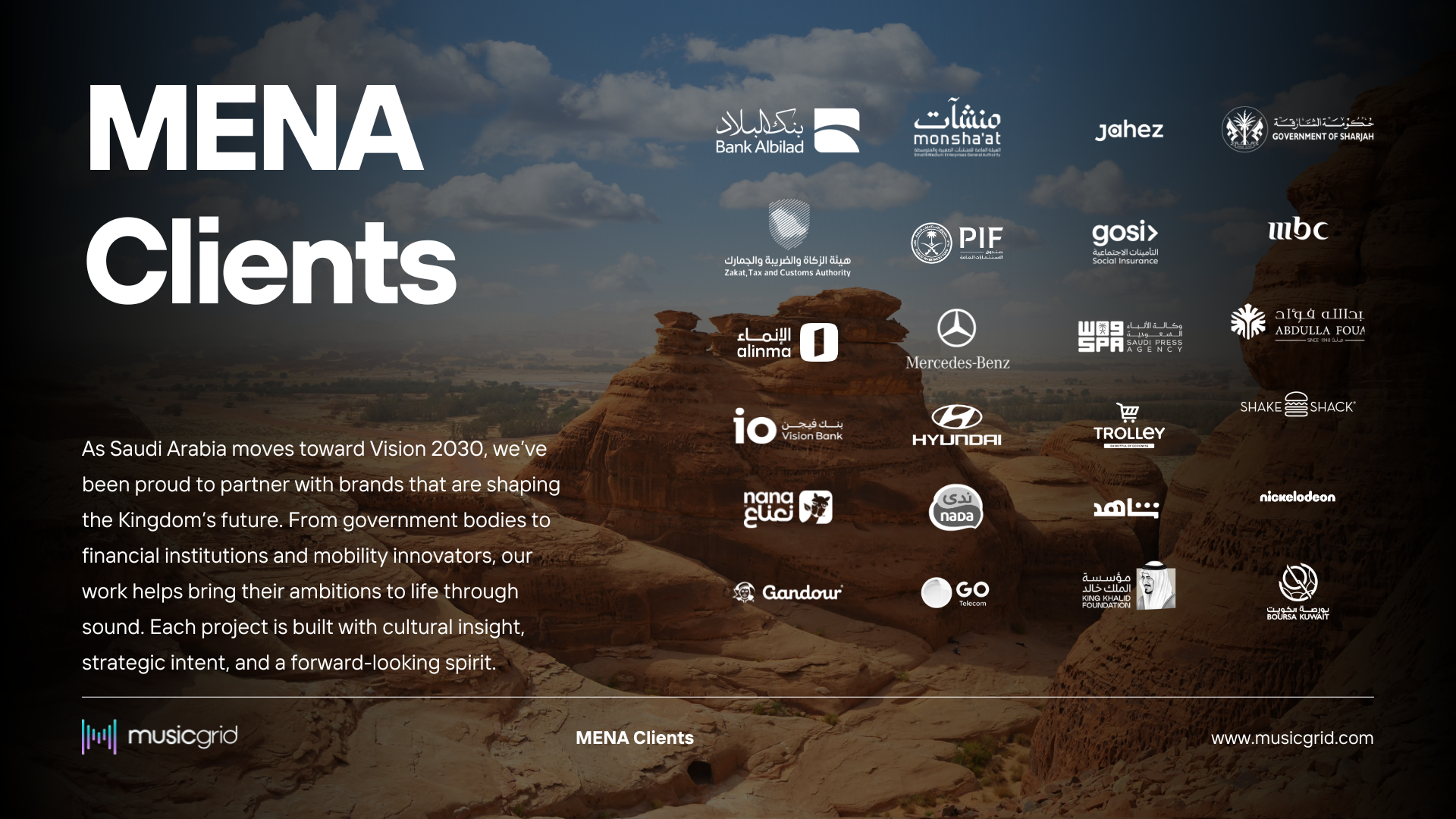
This is particularly important for brands operating across Saudi Arabia, the UAE and the wider GCC.
Regional campaigns sometimes need to balance global brand positioning with local cultural relevance.
That does not necessarily mean using traditional instrumentation in every campaign.
Cultural relevance can also come through rhythm, production style, instrumentation, melodic language, vocal treatment or collaboration with regional artists.
The goal should be authenticity rather than simply adding recognizable regional sounds.
For campaigns running across several markets, brands may also need to decide whether one soundtrack works everywhere or whether certain markets require localized adaptations.
Music Should Work With the Edit
Music and picture are closely connected.
Strong campaign music often responds directly to the structure of the film.
Changes in harmony, rhythm, instrumentation and intensity can help reinforce visual transitions and narrative moments.
This is one reason collaboration between composers, directors, editors and creative agencies is valuable.
Rather than treating music as something added at the end of production, teams can build the soundtrack alongside the development of the film.
Even relatively small musical decisions can significantly affect how an edit feels.
Build Recognition Across Multiple Campaigns
One of the biggest opportunities for established brands is thinking beyond individual advertisements.
If every campaign uses completely unrelated music, the brand may create many strong advertisements without developing any consistent audio recognition.
A broader sonic branding system can solve this.
Certain melodies, rhythms, instruments or sonic signatures can appear in different forms across multiple campaigns.
One advertisement might use an orchestral interpretation. Another might use electronic production. A third might reduce the same musical idea to a short sonic logo.
The creative expression changes while the underlying brand identity remains recognizable.
Over time, individual campaigns begin contributing to a larger sonic ecosystem.
Plan Music Rights Early
Music licensing should not be an afterthought.
Before finalizing the soundtrack, teams should understand:
- Where the campaign will run
- How long the music will be used
- Which platforms are included
- Which territories are included
- Whether paid media is involved
- Whether edits and adaptations are permitted
- Whether the music may be reused in future campaigns
These decisions can affect both the creative approach and the budget.
Clarifying usage requirements early helps avoid unnecessary complications closer to launch.
The Best Advertising Music Starts With Strategy
There is no single type of music that works for every advertisement.
Some campaigns benefit from recognizable licensed songs. Others need completely original compositions. Some require understated background music, while others build the entire creative concept around sound.
The most effective approach starts with a simple question:
What does the music need to do for this campaign and this brand?
Once that is clear, decisions around style, composition, licensing and production become much easier.
At MusicGrid, we work with brands and agencies across Saudi Arabia, the GCC and international markets to develop original music for advertising and campaign soundtracks designed around both the creative idea and the wider brand.
Frequently Asked Questions
- What is advertising music?
Advertising music is music used within commercials, branded content and marketing campaigns to support emotion, storytelling, brand identity and audience engagement. - Should brands use original or licensed music for advertising?
Both can work. Original music provides greater customization and brand ownership, while licensed tracks can provide familiarity and existing cultural associations. - What is custom music for advertising?
Custom advertising music is composed specifically for a campaign, allowing the soundtrack to follow the exact timing, emotion and creative direction of the advertisement. - Can advertising music be connected to sonic branding?
Yes. Campaign soundtracks can incorporate melodies, rhythms or other elements from a brand's sonic identity while still adapting creatively to each campaign. - Why should music be considered early in campaign production?
Early involvement allows music to develop alongside the film, making it easier to synchronize emotional moments, edit points and campaign adaptations.
.jpg)

.svg)

.svg)
.jpg)
.jpg)
.jpg)
.jpg)
.jpg)
.jpg)
.jpg)
.jpg)
.jpg)
.jpg)
.jpg)




.jpg)



.png)
.png)
.png)
.png)
.png)
.png)
.png)
.png)
.png)
.png)
.png)
.png)
.png)
.png)
.avif)
.jpg)
.jpg)

.png)
.png)

.png)

.png)

.png)







.png)
.png)
.png)
.png)
.png)
.png)
.jpg)
.jpg)
.jpg)
.jpg)
.jpg)
.jpg)

.jpg)
.jpg)
.jpg)
.jpg)
.jpg)
.jpg)
.jpg)
.jpg)

.png)
.jpg)

.jpg)

.png)
.png)


.png)
.png)


.png)
.jpg)
.jpg)
.jpg)

.jpg)
.png)
.png)

.svg)
.svg)


.svg)
.svg)

.svg)


.svg)