
.svg)
.jpg)
Music for Advertising: How Brands Choose the Right Sound for Campaigns
A strong advertising campaign can communicate a message in seconds. Music plays a major role in determining how those seconds feel.
.jpg)
Brands across the GCC are investing heavily in how they look.
They develop detailed visual identities, define their colors and typography, and create clear rules for how their brand should appear across different markets and platforms.
But when it comes to sound, many brands still operate without the same level of structure.
One campaign may sound cinematic. Another may use trendy electronic music. A Ramadan campaign may introduce a completely different musical identity. Meanwhile, the mobile application, events and customer-service channels may use unrelated sounds.
Individually, each piece of audio may work. Collectively, however, the brand sounds inconsistent.
Audio branding solves this problem by defining how a brand should sound and creating a flexible system that can be used across different customer touchpoints.
For brands operating across Saudi Arabia and the wider GCC, this system must provide consistency while still allowing for different markets, languages, cultures and occasions.
The process should begin with strategy, not composition.
Before creating a sonic logo or brand theme, the organization needs to define what its sound should communicate.
This starts with questions such as:
A brand that wants to communicate trust, progress and authority requires a different musical identity from one built around energy, playfulness and accessibility.
Without a clear strategy, audio decisions are likely to depend on individual taste. The result may sound good without clearly representing the brand.
A single piece of music is not a complete audio identity.
A brand may create an impressive theme, use it for one launch campaign and then struggle to apply it anywhere else.
A stronger sonic branding system is designed to work across different durations, moods, platforms and situations.
It may include:
All these assets should share recognizable musical characteristics.
This does not mean they need to sound identical. They may have different arrangements, instruments and levels of energy while still belonging to the same brand.
A brand’s audio identity becomes recognizable when certain elements appear consistently over time.
These elements could include:
These elements form the musical foundation of the brand.
For example, the core melody may appear clearly in a brand film, subtly within a Ramadan adaptation and in a simplified form inside a mobile notification.
The execution changes, but the underlying identity remains.
This is similar to how a visual brand uses the same colors and design principles across different formats without making every piece of communication look identical.
Many GCC brands operate across Saudi Arabia, Kuwait, the UAE, Qatar, Bahrain and Oman.
These markets share important cultural connections, but they should not be treated as identical.
A regional audio identity should provide one recognizable foundation while allowing thoughtful local adaptations.
The core sonic logo or melody may remain consistent across the GCC, while other elements can change according to the market or occasion.
Adaptable elements may include:
The objective is to avoid two extremes.
If every market uses completely different music, the brand loses regional consistency. If every market receives exactly the same execution, the sound may lack local relevance.
A strong audio system creates consistency at the center and flexibility around it.
Cultural relevance does not come from simply adding an oud, qanun or Arabic percussion to a soundtrack.
These instruments can be powerful, but they should be used with purpose.
The GCC contains a wide range of musical traditions and cultural identities. Saudi, Kuwaiti, Emirati, Qatari, Bahraini and Omani influences should not be reduced to one generic “Middle Eastern” sound.
Brands should consider which cultural cues are appropriate, what they communicate and how prominently they should appear.
In some cases, the brand may need a clearly traditional performance. In others, cultural influence may be expressed subtly through rhythm, melody or production.
The goal is not to prove that the music is regional. It is to create something that feels natural, informed and relevant to the audience.
Audio branding should be created around how people actually interact with the brand.
A sonic logo may sound impressive in a presentation, but it also needs to work at the end of a six-second advertisement, through a mobile speaker and inside a busy event environment.
Before finalizing the identity, brands should identify their most important sonic touchpoints.
These may include:
Each touchpoint has different functional and emotional requirements.
A notification sound must be short and pleasant after repeated use. Event music needs enough development to support a longer experience. Customer-service audio should feel reassuring without becoming distracting.
Designing for real applications ensures the sound becomes useful, not merely impressive.
Many GCC brands communicate in both Arabic and English.
A nonverbal sonic logo can remain consistent across languages, but campaign music, vocals, jingles and voice-over applications may require different versions.
Translation alone is not always enough.
Arabic and English have different rhythms, phrase lengths and vocal characteristics. A melody designed around English lyrics may not work naturally when translated into Arabic, and the same applies in reverse.
The audio system should account for multilingual use from the beginning.
This may involve creating:
Planning these requirements early creates better results and reduces rushed adaptations later.
Ramadan, Eid and national celebrations are major communication moments for brands across the GCC.
During these occasions, many organizations replace their usual music with a completely unrelated seasonal track.
The campaign may feel appropriate for the moment, but the brand’s identity disappears.
A better approach is to create a seasonal adaptation of the existing sonic identity.
The core melody or sonic logo can remain recognizable while the arrangement, instrumentation and emotional tone change.
A Ramadan version may feel warmer, more reflective and intimate. A Saudi National Day adaptation may feel proud, celebratory and energetic.
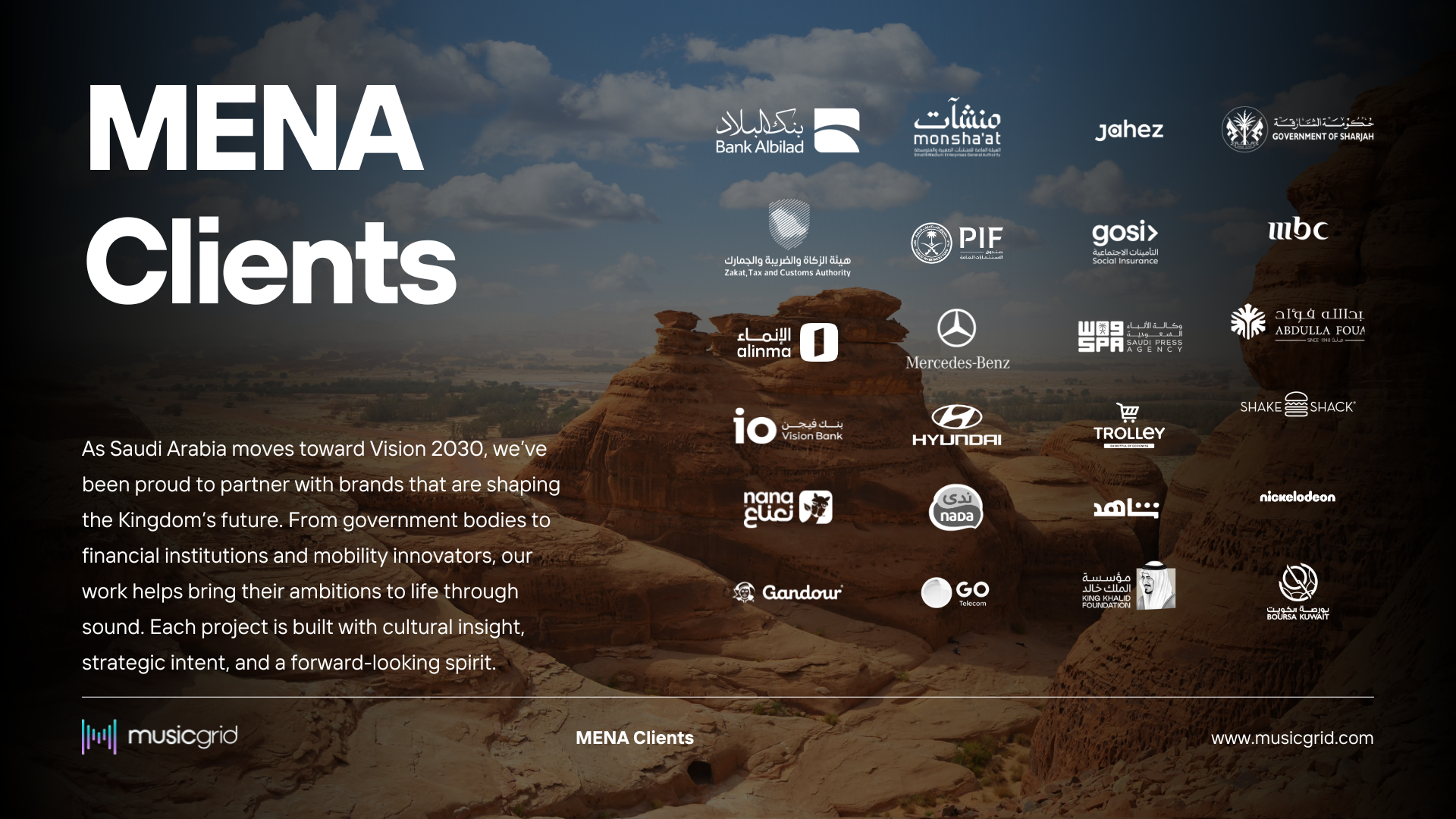
MusicGrid’s work on the ZATCA sonic identity, for example, included a core DNA track supported by dedicated digital and Ramadan adaptations.
Each version serves a different purpose while remaining connected to the same organization.
Even a strong sonic identity can become inconsistent if teams do not know how to use it.
Audio branding guidelines should explain:
The guidelines should be practical rather than overly technical.
Marketing teams, production companies, agencies and content creators should be able to understand them without needing a background in music.
Audio files are often scattered across emails, agency folders, individual computers and cloud-storage links.
Over time, teams may no longer know which version is current or approved.
A centralized audio library should include final masters, alternative versions, cutdowns, stems, sonic logos and usage guidelines.
Files should be named clearly and consistently.
The library should also distinguish between:
Good organization makes consistent implementation much easier. It also prevents old or incorrect assets from returning in future campaigns.
Large GCC organizations often work with multiple departments, agencies and production partners.
Without clear governance, each team may interpret the brand’s sound differently.
The organization should define:
Governance should support creativity, not block it.
The purpose is to give teams a clear framework so they can create new work without losing the brand’s recognizable sound.
Music is subjective, which makes internal approval difficult.
Senior stakeholders may have strong personal preferences that do not reflect how the target audience experiences the sound.
Research can help brands evaluate the work more objectively.
Testing may explore:
The purpose is not to choose whichever track receives the most votes.
Testing should reveal whether the sound communicates the intended identity and performs the role it was created to perform.
Audio branding is a long-term brand asset, so its effectiveness should not be judged only through campaign views or social engagement.
Brands can evaluate its impact through:
These measurements can be taken before and after launch to identify how audience perception changes.
The objective is to understand whether the sound is becoming associated with the brand—not merely whether people liked one piece of music.
A sonic identity should be consistent, but it should not remain frozen forever.
Brands grow, enter new markets, launch new products and adopt new platforms. Their sound must be able to respond.
This does not necessarily mean replacing the original identity.
The system can evolve through:
The recognizable foundation should remain unless there is a strategic reason to change it.
MusicGrid’s work on the GOSI sonic revamp demonstrates how an existing identity can be modernized for new contexts while preserving its core musical recognition.
Audio branding is most effective when it is treated as a long-term identity system rather than a one-time music project.
The strongest systems give GCC brands one recognizable sound while allowing enough flexibility for different markets, languages, campaigns and cultural moments.
MusicGrid creates complete sonic branding systems for organizations across Saudi Arabia, the GCC and the wider MENA region.
Our approach combines strategy, original music, regional understanding, testing, governance and practical implementation across customer touchpoints.
Contact MusicGrid to build a consistent and culturally relevant sound for your brand.

.svg)
.jpg)
.jpg)



.jpg)


.png)
.png)
.png)
.png)
.png)
.png)
.png)
.png)
.png)
.png)
.png)
.png)
.png)
.avif)
.jpg)
.jpg)

.png)
.png)
.png)

.png)

.png)






.png)
.png)
.png)
.png)
.png)
.jpg)
.jpg)
.jpg)
.jpg)
.jpg)
.jpg)
.jpg)
.jpg)
.jpg)
.jpg)
.jpg)
.jpg)

.jpg)

.jpg)
.png)
.png)

.jpg)
.png)
.png)


.svg)
.svg)

.svg)

.jpg)
.jpg)
.jpg)
.jpg)
.jpg)
.jpg)
.jpg)
.jpg)


.png)


.png)
.jpg)

.jpg)
.png)


.png)
.png)


.png)
.jpg)
.jpg)
.jpg)

.svg)
.svg)


.svg)