Original music can transform an advertisement.
It can establish the emotional tone, support the story, emphasize important moments and give the campaign a sound that audiences will not hear anywhere else.
But creating music for advertising involves more than composing a track and placing it beneath a film.
The music must work with the campaign concept, brand, audience, voice-over, visuals, edit and intended media. It may also need to function across different durations, languages and platforms.
A soundtrack that works perfectly in a 60-second brand film may not automatically work in a six-second advertisement.
This guide explains how original music is created for advertising campaigns, from the initial brief to the delivery of the final masters.
What Is Original Music for Advertising?
Original advertising music is composed and produced specifically for a campaign, brand or piece of communication.
Unlike stock music, it does not exist before the project begins.
The soundtrack is developed around requirements such as:
- The campaign concept
- The brand’s personality
- The audience
- The desired emotional response
- The film or script
- The voice-over
- The product or service
- The campaign message
- Cultural context
- Required durations
- Media and platforms
- Existing sonic brand assets
Original advertising music may be instrumental or include vocals and lyrics.
It can take several forms, including:
- A cinematic campaign soundtrack
- An original advertising song
- A short vocal hook
- A product jingle
- Music synchronized closely with a film
- A branded musical theme
- An adaptation of an existing sonic identity
- Music created for a national or cultural occasion
- Multiple campaign tracks built from one musical idea
The production process depends on the scale and creative needs of the campaign.
Why Do Brands Create Original Campaign Music?
Brands usually commission original music when the soundtrack needs to do something that pre-existing music cannot achieve easily.
The music may need to follow the film precisely, communicate a distinctive brand personality or develop around a particular campaign message.
Original music may be appropriate when:
- Music is central to the creative concept
- The campaign requires a distinctive soundtrack
- The film contains important synchronization points
- The brand needs Arabic, English or bilingual lyrics
- The soundtrack must include a brand or product name
- Several durations and versions are required
- The campaign needs specific cultural influences
- A sonic logo must be incorporated
- The soundtrack will be used across multiple touchpoints
- The music could become a long-term brand asset
- Greater ownership or usage control is required
Original composition gives the creative team greater control over what the audience hears and how the music supports the campaign.
The Original Advertising Music Production Process
The exact workflow varies between projects, but original advertising music usually moves through several key stages.
These include:
- Briefing and discovery
- Creative and musical direction
- Initial composition
- Presentation and evaluation
- Feedback and revisions
- Recording and full production
- Synchronization and adaptation
- Mixing and mastering
- Final delivery and asset organization
Each stage helps ensure the final music serves both the advertisement and the brand.
Stage 1: Briefing and Discovery
The process begins with understanding the campaign.
Before composing anything, the music team needs to know what the communication is trying to achieve.
A useful brief should explain:
- Who the brand is
- What the campaign is about
- The central message
- The target audience
- What the audience should think, feel or do
- The role music should play
- The intended emotional journey
- Where the advertisement will appear
- The required durations and versions
- The timeline and budget
- The expected usage and rights
The music team may also review:
- The campaign strategy
- Creative concept
- Script
- Storyboard
- Animatic
- Rough cut
- Locked film
- Brand guidelines
- Previous advertising
- Competitor campaigns
- Existing musical references
- The brand’s sonic identity
The objective is not simply to discover what genre the client likes.
It is to understand the communication problem the music needs to solve.
A request for “uplifting music,” for example, could refer to several very different emotions.
It might mean optimistic and youthful, emotional and inspiring, confident and corporate, energetic and entertaining, or culturally proud and celebratory.
Discovery gives these general descriptions a clearer meaning.
Stage 2: Defining the Role of Music
The next step is to define what the soundtrack should contribute to the advertisement.
Music can perform several functions within the same campaign.
It may:
- Capture attention
- Establish the setting
- Build anticipation
- Communicate emotion
- Support the pace
- Emphasize a product reveal
- Create contrast
- Reinforce a cultural context
- Make the campaign more memorable
- Connect different scenes
- Support the voice-over
- Introduce the sonic logo
- Provide a recognizable campaign hook
A soundtrack created to sit quietly beneath a detailed voice-over will be approached differently from a song that carries the entire campaign.
The role of music should be agreed upon before composition begins.
Otherwise, different stakeholders may evaluate the same soundtrack according to completely different expectations.
One person may want the music to feel subtle and supportive, while another expects it to become the most memorable part of the film.
Stage 3: Developing the Creative Music Direction
Once the brief is understood, the music team develops a creative direction.
This translates the campaign strategy into a practical musical territory.
The direction may define:
- Emotional tone
- Energy
- Tempo
- Musical style
- Instrumentation
- Cultural influence
- Vocal approach
- Production style
- Overall structure
- Relationship with the film
- Use of existing sonic assets
For example, a Saudi brand campaign may require music that feels modern, ambitious and rooted in local culture.
That does not automatically mean using the loudest traditional instruments throughout the soundtrack.
The direction could instead combine contemporary production with a regional rhythm, a specific performance technique or subtle traditional instrumentation.
The creative direction should explain why these choices support the campaign.
How Musical References Are Used
Brands and agencies often share reference tracks during the briefing stage.
References can be useful for communicating:
- Energy
- Pace
- Instrumentation
- Emotional development
- Vocal style
- Production quality
- Cultural direction
- The relationship between music and film
However, the reference should not become a request to reproduce another song.
A strong music team identifies the underlying characteristics that make the reference effective and develops a new composition from them.
For example, the team may determine that the client responds to:
- A gradual emotional build
- Minimal instrumentation at the beginning
- A memorable vocal hook
- Percussion that enters during the product reveal
- A warm and human performance
- A modern production style
- A strong ending for the brand logo
These characteristics can inspire an original direction without copying the melody, lyrics or composition.
Stage 4: Composing the Initial Music
The composer begins creating the musical idea once the direction is established.
The starting point varies according to the campaign.
It may begin with:
- A melody
- A rhythm
- A chord progression
- A vocal phrase
- A lyrical hook
- A sound or texture
- A sonic logo
- The timing of the film
- A particular emotional turning point
The composer then develops the idea into a structure that supports the advertisement.
An initial composition may be presented as a polished demo or a more developed production, depending on the agreed process.
Even during the demo stage, the music should communicate the central creative idea clearly enough for stakeholders to evaluate it.
How Many Initial Music Directions Should Be Created?
Some projects begin with one focused direction, while others include several musical routes.
The appropriate number depends on:
- The clarity of the brief
- The campaign’s importance
- The number of possible creative territories
- The available budget
- The production timeline
- The client’s approval process
- Whether a creative direction was agreed upon beforehand
Presenting more directions does not automatically lead to a better result.
Too many unrelated options can make the decision subjective and encourage stakeholders to select individual elements from several tracks without considering the strength of each complete idea.
A smaller number of well-developed directions is often more useful.
Each direction should have a clear strategic reason for existing.
Stage 5: Composing to the Film
When a rough or locked edit is available, the music can be composed directly around the film.
The composer reviews important moments such as:
- Scene changes
- Character movements
- Product appearances
- Text appearing on screen
- Emotional turning points
- Voice-over pauses
- Logo reveals
- The final call to action
These moments may become synchronization points.
The music does not need to emphasize every visual change. Doing so can make the soundtrack feel overly mechanical.
Instead, the composer decides which moments should be supported, anticipated or intentionally left unaccented.
For example, the music might gradually build before the product appears and then become simpler when the voice-over delivers the campaign’s main message.
The objective is to create a natural relationship between sound and picture.
Can Music Production Begin Before the Film Is Finished?
Yes. Music can begin from a script, storyboard, animatic or rough cut.
Starting early may help the production team establish the emotional tone and pacing of the film.
However, detailed synchronization usually requires a stable edit.
If the film changes after the music has been composed, the soundtrack may need to be restructured.
Even a change of one or two seconds can affect:
- Musical transitions
- Tempo
- The placement of the main melody
- Voice-over space
- Product reveals
- Climaxes
- The final sonic logo
The project schedule should therefore clarify when the edit is expected to become locked and how later picture changes will be handled.
Stage 6: Creating Lyrics and Vocals
Some advertising campaigns require an original song, jingle or vocal hook.
The lyrical process should begin with the campaign message.
Lyrics may need to communicate:
- The product benefit
- The brand name
- The campaign line
- A cultural occasion
- A specific emotion
- A call to action
- A short memorable phrase
Advertising lyrics usually need to communicate quickly.
They should also sound natural when sung.
A sentence that works in written copy may contain too many syllables, awkward stresses or words that are difficult to understand within a melody.
The music and copy teams may therefore need to adjust the wording together.
Producing Arabic and English Versions
Multilingual campaigns require more than direct translation.
Arabic and English have different rhythms, sentence lengths, stresses and phrasing.
A direct translation may communicate the correct meaning but fit the melody poorly.
Depending on the campaign, the production may require:
- Separate Arabic and English lyrics
- Adapted lyrical meanings
- Different melodic phrasing
- Bilingual vocals
- Instrumental versions
- Separate voice-over mixes
- Language-specific endings
- Different singers for each language
The objective is for every version to feel natural rather than making one language sound like a secondary adaptation.
Regional dialect should also be considered when the campaign targets a specific market.
Selecting the Right Vocalist
The vocalist becomes part of how the campaign sounds.
The selection should be based on more than technical singing ability.
Important considerations include:
- Vocal tone
- Age perception
- Accent and pronunciation
- Emotional delivery
- Cultural fit
- Genre experience
- Energy
- Clarity
- Brand suitability
- Audience relevance
A highly dramatic singer may overpower a restrained brand film. A polished commercial voice may feel unsuitable for a campaign that needs intimacy and authenticity.
Casting should reflect the personality of the communication.
If the campaign includes a recognized artist, additional considerations may include artist approval, scheduling, recording requirements, image rights and public association with the brand.
Stage 7: Presenting the Music
Music should be presented with enough context for stakeholders to understand the thinking behind it.
A useful presentation may explain:
- The creative idea
- How it reflects the campaign
- The intended emotional journey
- The musical structure
- Important instruments or sounds
- Cultural influences
- How the music interacts with the film
- Where the brand appears musically
- How the direction can extend into shorter versions
This does not require complicated musical terminology.
The explanation should help non-musicians evaluate whether the direction achieves the campaign objective.
The music should ideally be heard in the correct environment.
If it was composed to picture, stakeholders should review it with the film rather than listening only to the audio file.
Stage 8: Collecting Client Feedback
Feedback is one of the most important parts of original music production.
Music is subjective, but the review process does not need to rely entirely on personal taste.
Useful feedback connects the requested change to the campaign.
For example:
- The introduction feels too serious for the campaign’s optimistic message.
- The voice-over becomes difficult to understand when the percussion enters.
- The product reveal needs a stronger sense of arrival.
- The cultural influence feels too prominent for the brand’s modern positioning.
- The main melody should appear earlier so it can work in the 15-second version.
- The ending feels too dramatic for the intended call to action.
These comments give the composer a clear problem to solve.
Comments such as “make it better,” “make it more premium” or “we do not feel it yet” require further explanation.
The music team may need to ask:
- Which section feels incorrect?
- What emotion does it currently communicate?
- What should the audience feel instead?
- Is the issue related to the composition, sound selection, performance or mix?
- Does the problem appear when the track is heard alone or only with the film?
Clear feedback leads to more effective revisions.
Why Feedback Should Be Consolidated
Campaign music may be reviewed by marketing teams, brand teams, creative agencies, production companies, directors and senior leadership.
All of these stakeholders may have relevant perspectives.
However, sending conflicting comments separately can make the revision process difficult.
For example:
- One stakeholder may request more energy.
- Another may ask for the music to feel calmer.
- A third may want additional instruments.
- A fourth may want the arrangement to become simpler.
The client team should resolve major conflicts and submit one consolidated set of feedback through an agreed point of contact.
This protects the clarity of the creative direction and reduces unnecessary revision rounds.
Stage 9: Revising the Composition
Revisions may involve small production adjustments or larger compositional changes.
Possible revisions include:
- Changing the melody
- Adjusting the tempo
- Replacing instruments
- Simplifying the arrangement
- Increasing or reducing energy
- Creating more space for voice-over
- Strengthening the ending
- Moving the main hook earlier
- Adjusting the cultural influence
- Rewriting lyrics
- Re-recording vocals
- Changing the relationship with the film
- Integrating the sonic logo differently
The agreed scope should define how many revision rounds are included and what counts as a new creative direction.
Changing a specific instrument is different from requesting a completely new composition after a direction has been approved.
Clear approval stages help the project move forward efficiently.
Stage 10: Full Music Production
Once the composition and direction are approved, the track moves into full production.
This stage may include:
- Detailed arrangement
- Sound selection
- Programming
- Live-instrument recording
- Vocal recording
- Editing
- Additional sound design
- Production effects
- Performance refinement
- Final synchronization
The production should support the musical idea rather than overwhelm it.
A large orchestra is not automatically more effective than a simple arrangement.
The right production approach depends on the campaign, brand and intended emotional response.
A restrained film may need only a few carefully recorded elements. A major launch campaign may justify a full ensemble, choir, recognized vocalist or orchestral recording.
Using Live Musicians
Live musicians may add human expression, cultural authenticity and performance detail that are difficult to recreate electronically.
They may be particularly valuable when the campaign requires:
- Traditional regional instruments
- Expressive strings
- Live percussion
- Brass
- Choir
- Solo vocal performance
- Jazz or improvised elements
- A cinematic orchestra
The recording process may take place in a commercial studio, remotely or across several locations.
The music producer should ensure the performances feel consistent and work together within the final production.
The scope should also clarify performer agreements and usage rights.
Incorporating Saudi and Regional Musical Influences
Campaigns in Saudi Arabia and the wider GCC may require a culturally relevant musical approach.
This can involve:
- Regional rhythms
- Traditional instruments
- Local vocal styles
- Arabic lyrical phrasing
- Specific scales or modes
- Percussion traditions
- Contemporary interpretations of heritage
- Performers familiar with the relevant musical style
Cultural relevance should be developed carefully.
Simply adding oud or Arabic percussion does not automatically make a soundtrack authentically Saudi or appropriate for the campaign.
The musical choices should reflect the specific market, occasion, brand and audience.
A Saudi National Day campaign may require a different cultural approach from a technology launch, tourism film or financial-services advertisement.
The goal is not to make every campaign sound traditional.
It is to create music that feels credible within its context.
Integrating an Existing Sonic Identity
If the brand has a sonic identity, the campaign music can connect with it.
The soundtrack may incorporate:
- The sonic logo
- A recognizable melody
- A rhythmic pattern
- A harmonic structure
- Particular instruments
- A sound texture
- A vocal characteristic
- A defined emotional territory
The integration can be direct or subtle.
The sonic logo might appear clearly at the end of the advertisement. Alternatively, its notes may be developed into the campaign’s main melody.
This helps the music feel distinctive to the brand without requiring every campaign to use exactly the same soundtrack.
A well-designed sonic identity should provide recognizable ingredients that can adapt to different stories, moods and occasions.
Stage 11: Creating Different Campaign Durations
The master soundtrack is rarely the only version required.
Advertising campaigns may include:
- 60-second films
- 30-second commercials
- 15-second edits
- Six-second advertisements
- Social media cutdowns
- Vertical videos
- Radio spots
- Event content
- Website videos
- Digital banners with sound
- Internal launch content
Shorter edits should not simply cut the master track at an arbitrary point.
Each version should feel musically complete.
The composer may need to:
- Introduce the main melody earlier
- Shorten the build
- Create alternative transitions
- Produce a faster ending
- Move the sonic logo
- Simplify the arrangement
- Adjust the vocal hook
- Create a shorter product reveal
- Rebalance the voice-over mix
Planning these durations early can influence how the master composition is structured.
Stage 12: Mixing the Advertising Music
Mixing is the process of balancing and shaping every element within the soundtrack.
The mix engineer adjusts factors such as:
- Volume
- Frequency balance
- Stereo placement
- Dynamics
- Effects
- Depth
- Clarity
- Impact
Advertising music often needs to share space with:
- Voice-over
- Dialogue
- Sound effects
- Product sounds
- Environmental audio
- The sonic logo
A music mix that sounds impressive on its own may compete with the narration once placed in the final advertisement.
For this reason, the project may require several mixes, including:
- Full music mix
- Music-under-voice-over mix
- Instrumental mix
- Vocal mix
- No-melody mix
- Reduced-percussion mix
- Alternative ending
- Sonic-logo version
The post-production team can then select the most appropriate version for each film.
Stage 13: Mastering the Final Track
Mastering prepares the music for final delivery.
It helps ensure the soundtrack translates consistently across different listening environments.
Audiences may hear the campaign through:
- Television
- Cinema speakers
- Smartphones
- Headphones
- Car audio systems
- Radio
- Social media platforms
- Event sound systems
- Retail speakers
The mastering approach should consider how the music will actually be used.
The loudest possible master is not always the best choice.
Excessive compression can reduce emotional movement and create less space for voice-over or sound design.
Stage 14: Delivering Stems and Alternative Versions
Stems are separate audio files containing groups of musical elements.
A project may include stems for:
- Percussion
- Bass
- Main melody
- Harmony
- Strings
- Vocals
- Choir
- Regional instruments
- Electronic textures
- Sound design
- Sonic logo
Stems give the editing and post-production teams greater flexibility.
They can reduce the melody beneath important dialogue, remove vocals for another language version or build a shorter edit from the original musical components.
The delivery scope should specify which stems, versions and file formats are required.
What Files Should Be Delivered?
The final delivery may include:
- Full master
- Instrumental version
- Vocal version
- Voice-over mix
- Alternative mixes
- Approved duration edits
- Arabic version
- English version
- Bilingual version
- Sonic-logo ending
- Stems
- WAV files
- MP3 reference files
- Film-synchronized references
- Naming and version documentation
High-quality WAV files are generally used for final production.
MP3 files may be supplied for convenient review but should not replace the full-quality masters.
The files should use a clear naming structure so agencies and production partners can identify the correct asset easily.
Clarifying Music Ownership and Usage Rights
Original music is protected by copyright.
Commissioning a soundtrack does not automatically determine who owns the composition or master recording.
The agreement should clarify:
- Composition ownership
- Master recording ownership
- Licence duration
- Countries and territories
- Media and platforms
- Exclusivity
- Adaptation rights
- Editing rights
- Performer rights
- Vocalist rights
- Use by the brand’s agencies
- Future campaign use
- Portfolio use by the music agency
- Whether the brand can transfer or sublicense the music
These rights can affect the production budget.
A limited campaign licence is different from full ownership and unrestricted global usage.
The required rights should be discussed before production begins rather than after the final track has been approved.
How Long Does Original Advertising Music Take?
The timeline depends on the complexity of the project.
A straightforward instrumental soundtrack may be developed relatively quickly. A campaign involving several creative directions, original lyrics, multiple languages, live musicians and many adaptations will require more time.
The schedule may need to cover:
- Briefing
- Creative direction
- Composition
- Internal review
- Client review
- Revisions
- Lyric approval
- Vocal casting
- Recording
- Music production
- Mixing
- Mastering
- Adaptations
- Final delivery
Additional time may be required if the film changes, feedback is delayed or several stakeholders must approve the music.
The final deadline should be supported by clear review and approval dates.
What Affects the Cost of Original Advertising Music?
The cost depends on the creative, production and commercial scope.
Important factors include:
- Number of creative directions
- Duration of the music
- Complexity of the composition
- Number of revision rounds
- Live musicians
- Vocalists
- Original lyrics
- Recognized artists
- Studio recording
- Orchestral production
- Number of campaign versions
- Arabic and English adaptations
- Stems and alternative mixes
- Territories
- Media
- Usage period
- Exclusivity
- Ownership requirements
- Audience testing
A soundtrack for one short digital film will not have the same scope as music for a regional campaign running across television, cinema, radio, digital platforms and live events.
Sharing the available budget helps the music agency recommend the most appropriate production approach.
Common Problems During Advertising Music Production
Several issues can weaken the process.
Beginning Without a Clear Role for Music
If the team has not agreed on what the music should achieve, every stakeholder may judge it differently.
Selecting Music Based Only on Personal Taste
The strongest soundtrack is not necessarily the music preferred by the most senior person in the room. It should be evaluated according to the campaign, brand and audience.
Becoming Too Attached to the Temporary Track
Repeated exposure to temp music can make every original direction feel unfamiliar. The team should identify what works about the reference without expecting an imitation.
Involving Too Many Uncoordinated Stakeholders
Conflicting feedback can weaken the creative direction and extend the timeline.
Changing the Film After Music Approval
Picture changes may affect synchronization, structure and the placement of important musical moments.
Leaving Shorter Versions Until the End
The main musical idea may not fit naturally into six- or 15-second edits if these formats were not considered earlier.
Discussing Rights After Production
Ownership and usage expectations can have significant commercial implications and should be agreed upon in advance.
How Should Original Music Be Evaluated?
Original campaign music should be evaluated according to clear questions:
- Does it support the campaign message?
- Does it create the intended emotion?
- Does it feel suitable for the brand?
- Does it connect with the target audience?
- Does it work with the film?
- Does it leave enough space for voice-over?
- Does it emphasize the right moments?
- Is the main musical idea memorable?
- Is the cultural direction appropriate?
- Can it adapt to all required durations?
- Does it feel distinctive from competitors?
- Can it connect with the brand’s wider sonic identity?
The first question should not be, “Would I listen to this personally?”
Advertising music has a communication role. Its effectiveness depends on how well it performs that role.
Frequently Asked Questions
How Is Original Advertising Music Different From Stock Music?
Original advertising music is created specifically for the campaign. Stock music already exists and is licensed for use. Original music provides greater control over the composition, synchronization, branding and adaptations.
Does the Film Need to Be Finished Before Music Production Begins?
No. Composition can begin from a script, storyboard, animatic or rough cut. However, detailed synchronization and final timing usually require a stable or locked film.
How Many Music Directions Should a Brand Request?
This depends on the project. A small number of strategically distinct directions is usually more useful than many unrelated options.
Can Original Music Include a Brand’s Sonic Logo?
Yes. The sonic logo or another recognizable part of the brand’s sonic identity can be integrated into the composition, arrangement or ending.
Can the Same Music Be Used for Arabic and English Advertisements?
Yes, but different voice-over timings or lyrics may require alternative arrangements and mixes.
What Are Music Stems?
Stems are separate files containing groups of instruments or sounds, such as percussion, vocals, melody and strings. They make it easier to create campaign edits and adjust the music around voice-over.
How Many Revision Rounds Are Usually Included?
This depends on the commercial agreement. The scope should define the included revisions and distinguish between revising an approved direction and requesting a completely new composition.
Does the Brand Automatically Own Original Advertising Music?
No. Ownership and usage rights depend on the agreement between the brand and the composer or music agency.
Can Original Music Be Reused in Future Campaigns?
Yes, if the agreement includes the necessary future usage and adaptation rights. The music can also be structured as a longer-term campaign or brand asset.
Should Original Music Be Tested With Audiences?
Audience testing can be valuable for major campaigns or long-term sonic assets. Testing may assess emotional response, brand fit, distinctiveness and recognition.
Creating Music That Serves the Entire Campaign
Original advertising music should do more than make a film feel polished.
It should help communicate the idea, guide the audience’s emotions and strengthen the connection between the campaign and the brand.
The most effective process combines strategic direction with creative freedom.
It begins with a clear brief, develops through focused composition and feedback, and ends with music that works across every required version and platform.
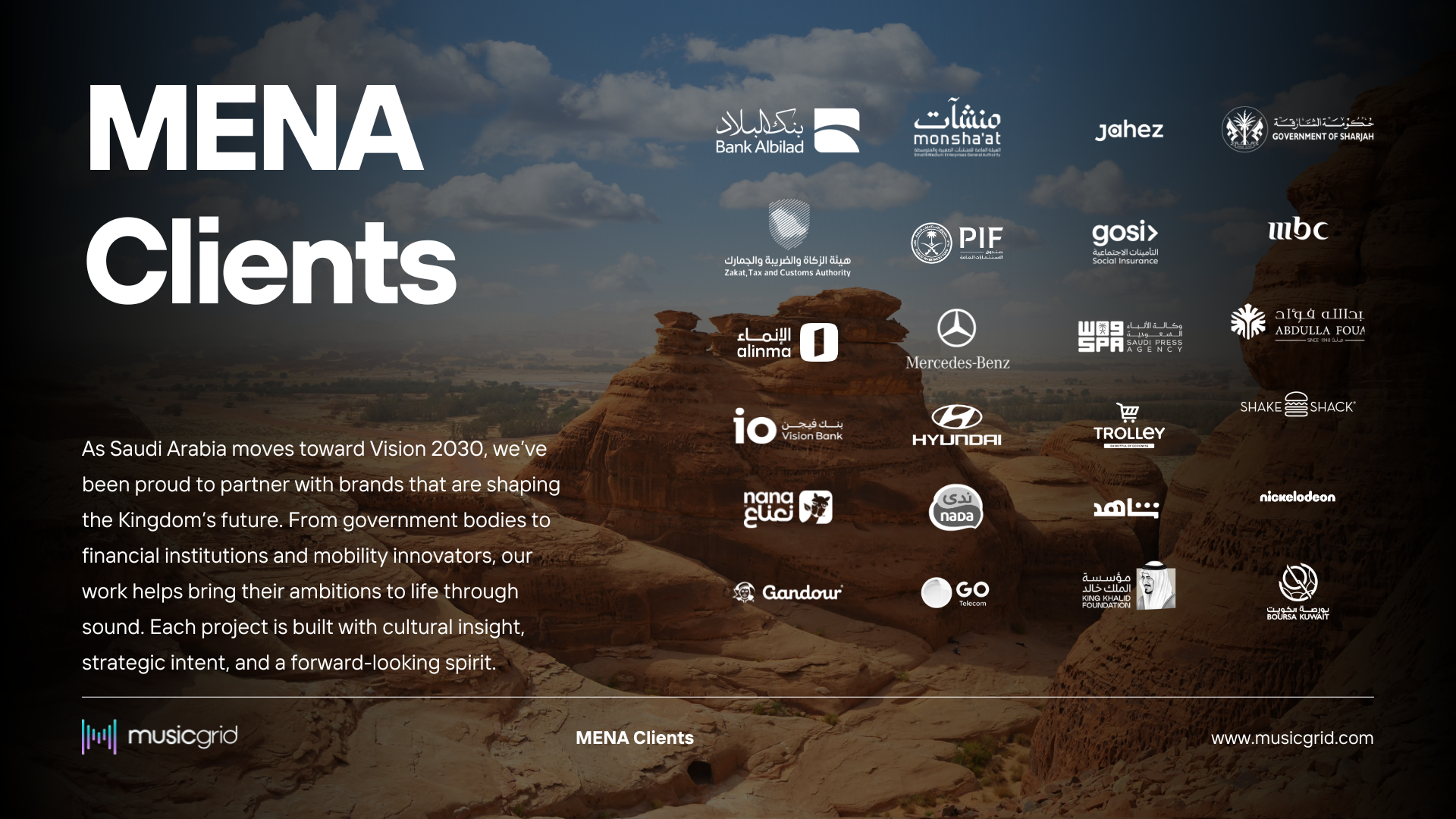
MusicGrid creates original music and campaign soundtracks for brands and agencies across Saudi Arabia, the GCC and the wider MENA region.
Our team manages the complete process, including creative direction, composition, lyrics, recording, production, adaptations and final delivery.
Contact MusicGrid to discuss original music for your next advertising campaign.
.jpg)

.svg)

.svg)
.jpg)
.jpg)
.jpg)
.jpg)
.jpg)
.jpg)
.jpg)
.jpg)
.jpg)
.jpg)




.jpg)



.png)
.png)
.png)
.png)
.png)
.png)
.png)
.png)
.png)
.png)
.png)
.png)
.png)
.png)
.avif)
.jpg)
.jpg)

.png)
.png)
.png)

.png)

.png)







.png)
.png)
.png)
.png)
.png)
.png)
.jpg)
.jpg)
.jpg)
.jpg)
.jpg)
.jpg)

.jpg)
.jpg)
.jpg)
.jpg)
.jpg)
.jpg)
.jpg)
.jpg)

.png)
.jpg)

.jpg)

.png)
.png)


.png)
.png)


.png)
.jpg)
.jpg)
.jpg)

.jpg)
.png)
.png)
.png)

.svg)
.svg)


.svg)
.svg)

.svg)


.svg)