Choosing music for a brand can seem simple.
Find a track that sounds good, matches the video and receives approval from the marketing team.
But music that sounds good is not necessarily right for the brand.
The right brand music should express the brand’s personality, create the intended emotional response and connect naturally with the audience. It should also remain effective across different campaigns, platforms and customer touchpoints.
For brands in Saudi Arabia and the wider GCC, another consideration is especially important: cultural relevance.
Music must feel connected to the audience without becoming predictable, stereotypical or disconnected from the brand’s modern identity.
Start With the Brand, Not the Music
One of the most common mistakes is beginning the process by discussing musical genres.
Should the music be electronic, orchestral, cinematic, Khaleeji or traditional?
These questions matter, but they should come later.
The first step is understanding what the brand represents.
Before choosing any musical direction, define:
- The brand’s personality
- Its values and positioning
- The audience it wants to reach
- The emotions it wants to create
- How it should differ from competitors
- Where the music will be used
A financial institution may want to communicate trust, progress and security. A food brand may want to express warmth, enjoyment and togetherness. A technology company may want to feel innovative, simple and optimistic.
These values should guide the music.
Otherwise, the result may sound attractive without sounding like the brand.
Define the Emotion Clearly
Music communicates emotion quickly, but general descriptions can lead to confusion.
Words such as “modern,” “premium” and “emotional” can mean completely different things to different people.
A premium soundtrack could feel minimal and refined, cinematic and powerful, or warm and sophisticated. An emotional soundtrack could express nostalgia, pride, hope, belonging or excitement.
The emotional direction should therefore be more specific.
Instead of asking for something “inspiring,” consider what kind of inspiration the audience should feel.
Should the music create:
- Confidence in the future?
- Pride in national progress?
- Warmth and familiarity?
- Excitement about a new product?
- Trust in an institution?
- A sense of belonging?
- Calmness during a customer experience?
The more clearly the intended emotion is defined, the easier it becomes to evaluate whether the music is working.
Understand the Audience
Brand music should not be selected only according to the preferences of the marketing team.
It should reflect the people the brand wants to reach.
Consider the audience’s age, location, language, lifestyle and relationship with the brand. A soundtrack designed for young digital users may require a different energy from music created for corporate investors or government stakeholders.
The same applies across GCC markets.
Saudi Arabia, Kuwait, the UAE, Qatar, Bahrain and Oman share many regional connections, but they should not be treated as one identical audience.
A musical direction that feels culturally meaningful in one market may need to be adapted in another. Even when a brand uses one regional identity, the execution should leave room for local relevance.
Consider Cultural Relevance Without Relying on Clichés
Regional relevance does not simply mean adding an oud, ney or Arabic percussion to a track.
Traditional instruments can be powerful, but they should be used intentionally.
The first question should be why the cultural element is present.
Does it express heritage? National pride? Warmth? Hospitality? Celebration? A connection between tradition and progress?
If there is no clear reason, the music may feel decorative rather than authentic.
Culturally relevant brand music can be created through many elements, including rhythm, melody, musical scales, instrumentation, vocal style, language, arrangement and production techniques.
Sometimes, a subtle regional rhythm is more effective than placing traditional instruments at the front of the arrangement.
In other situations, a strongly recognizable cultural performance may be exactly what the campaign needs.
The right choice depends on the brand, audience and context.
Avoid Treating Middle Eastern Music as One Sound
The Middle East contains a wide range of musical traditions, styles and identities.
Saudi music is not identical to Kuwaiti music. Khaleeji music is not interchangeable with Levantine, Egyptian or North African music.
Even within Saudi Arabia, musical traditions differ across regions and communities.
Brands should therefore be careful when using broad descriptions such as “Arabic music” or “Middle Eastern sound.”
A stronger brief identifies the specific cultural influence required and explains why it supports the campaign.
This makes the music feel more informed, respectful and distinctive.
specific cultural influence required and explains why it supports the campaign.
This makes the music feel more informed, respectful and distinctiveIt also reduces the risk of producing a generic regional soundtrack that could belong to almost any brand.
Decide Whether the Music Should Feel Traditional, Modern or Hybrid
Many Saudi and GCC brands want to express both heritage and progress.
Music can create this balance through a hybrid approach.
For example, a soundtrack might combine:
- Regional percussion with electronic production
- Oud or qanun with contemporary strings
- Traditional rhythms with modern sound design
- Arabic vocals with a global production style
- Local melodic influences with cinematic arrangements
The objective is not simply to place old and new sounds together. The elements should feel like one coherent musical direction.
The balance will depend on the brand.
A heritage organization may place traditional performance at the center. A fintech application may use cultural influences much more subtly. A national campaign may require a stronger sense of pride and collective identity.
There is no single sound that represents every modern Saudi or GCC brand.
Choose Music for the Intended Touchpoint
Music should be selected according to where and how it will be experienced.
A soundtrack created for a 60-second brand film may not work as effectively in a six-second social media advertisement. Music designed for an event may not be suitable for a mobile application.
Before approving a direction, consider whether the music will be used across:
- Television commercials
- Social media
- Brand films
- Mobile applications
- Events and activations
- Retail spaces
- Customer-service systems
- Radio
- Podcasts
- Internal communications
Each touchpoint has different requirements.
Digital content may need to create impact immediately. Event music may require a longer emotional progression. Application sounds need to be short, functional and pleasant after repeated use.
If the music will appear across several channels, it should be designed as a flexible sonic identity rather than one fixed track.
Consider Seasonal and National Campaigns
Brands in Saudi Arabia and the GCC communicate during several important cultural and national moments.
These may include:
- Ramadan
- Eid
- Saudi National Day
- Founding Day
- Other GCC national celebrations
- Major regional sporting and cultural events
Music created for these occasions should feel relevant to the moment while remaining connected to the brand.
A common mistake is replacing the brand’s usual sound with completely unrelated seasonal music. The campaign may feel appropriate for the occasion, but it stops sounding like the brand.
A stronger approach is to adapt recognizable parts of the brand’s existing music.
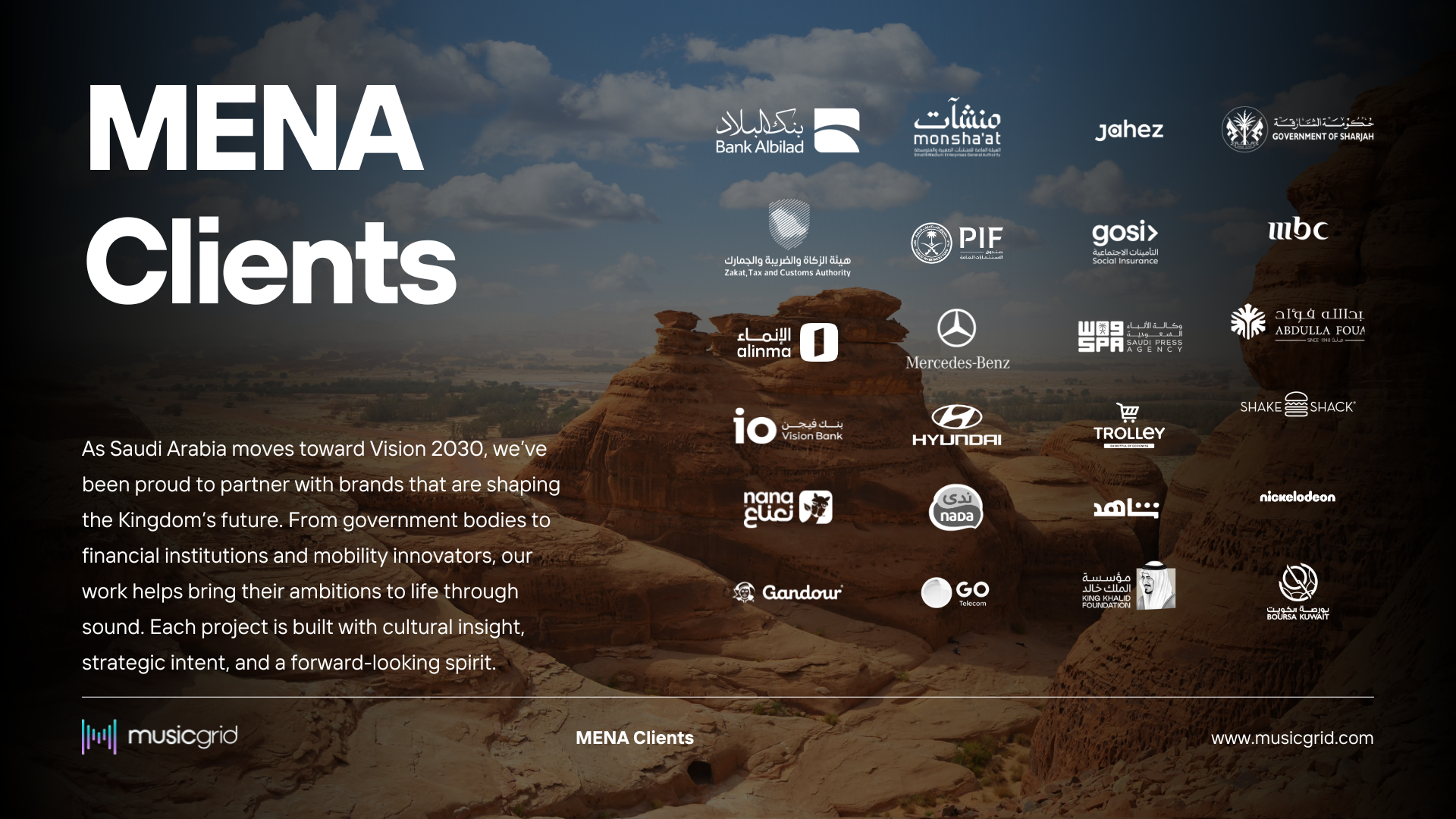
For example, MusicGrid’s work on the ZATCA sonic identity included a core brand theme alongside dedicated digital and Ramadan adaptations.
The melody, rhythm or instrumentation can change, but a consistent musical element should remain. This helps the brand participate in the occasion without losing its identity.
Choose Between Stock and Original Music
Stock music can be practical when a campaign has limited time or budget.
However, it also creates several limitations.
The music was not created around the brand, may not fit the edit perfectly and could be used by other companies. It can support the content without building a distinctive connection to the brand.
Original brand music provides more control.
The composition can be created around the brand’s personality, campaign message, cultural context and exact timing. It can also be delivered in different versions for television, digital platforms, events and future campaigns.
The right option depends on the project.
For temporary or low-priority content, stock music may be sufficient. For major campaigns or long-term brand building, original music usually provides greater strategic value.
Evaluate Distinctiveness, Not Just Quality
High-quality music is not automatically distinctive.
A soundtrack can be professionally produced and emotionally effective while still sounding similar to many competitors.
When reviewing musical options, ask:
- Could this music belong to another brand?
- Does it communicate our personality?
- Is there a recognizable musical idea?
- Will audiences remember anything about it?
- Can it develop into different versions?
- Does it avoid overused industry conventions?
- Will it still feel relevant in several years?
The aim is not to create something unusual simply for the sake of being different.
The music should be both appropriate and recognizable.
MusicGrid’s sonic identity for Nada Dairy, for example, was designed to express the brand’s warmth, freshness and established presence in Saudi homes while remaining flexible across different moments and applications.
Avoid Choosing Music by Committee
Music is subjective, which makes group approval difficult.
One person may prefer cinematic music. Another may want something more modern. Someone else may reject an option because it does not match their personal listening preferences.
This can turn the process into a vote based on taste.
A better approach is to evaluate every direction against agreed criteria:
- Does it reflect the brand?
- Does it create the intended emotion?
- Is it appropriate for the audience?
- Does it feel culturally relevant?
- Is it distinctive?
- Can it work across the required touchpoints?
- Can it grow with the brand?
Personal preference will always influence musical feedback, but it should not become the main decision-making method.
Plan for Long-Term Consistency
Brand music becomes more valuable through consistent use.
If every campaign uses a completely different style, the brand may create strong individual advertisements without building a recognizable identity.
Consistency does not mean repeating the same track forever.
A brand can create different moods, arrangements and campaign soundtracks while retaining certain recognizable elements.
These could include:
- A core melody
- A sonic logo
- A signature rhythm
- A specific instrument
- A consistent vocal character
- A recognizable production style
These elements form the foundation of a wider sonic identity.
They allow the brand to sound different when the context changes while still remaining familiar.
Frequently Asked Questions
- What is brand music? Brand music is music selected or created to express a brand’s identity. It may include campaign soundtracks, a core brand theme, a sonic logo and adaptations for different platforms or occasions.
- How should a brand choose its music? The decision should be based on the brand’s personality, audience, intended emotion, cultural context, touchpoints and long-term strategy—not only personal musical preferences.
- Should Saudi brands always use traditional instruments? No. Traditional instruments should only be used when they support the brand and creative direction. Saudi identity can also be expressed through rhythm, melody, performance style and modern production.
- Can the same brand music work across every GCC market? A common musical identity can work regionally, but some adaptations may be needed. Each market has its own cultural context, audience expectations and communication requirements.
- Is original music better than stock music? Original music offers greater distinctiveness, control and flexibility. Stock music can be suitable for temporary or lower-priority content, but it is less likely to build long-term recognition.
- Can brand music change between campaigns? Yes. The mood, arrangement and instrumentation can change while recognizable musical elements remain consistent.
- What is the difference between brand music and sonic branding? Brand music may refer to an individual track or selection of music. Sonic branding is a broader strategic system that defines how the brand should sound across different touchpoints.
Creating Music That Belongs to Your Brand
The right brand music should do more than match the visuals.
It should express the brand’s personality, create the intended emotion and connect naturally with the audience. It should also be flexible enough to work across different campaigns, platforms and markets.
For Saudi and GCC brands, the strongest music balances cultural understanding with a clear and distinctive brand identity.
MusicGrid creates original brand music and campaign soundtracks, as well as complete sonic identities for organizations across Saudi Arabia, the GCC and the wider MENA region.
Contact MusicGrid to create music that belongs to your brand.
.jpg)

.svg)

.svg)
.jpg)
.jpg)
.jpg)
.jpg)
.jpg)
.jpg)
.jpg)
.jpg)
.jpg)
.jpg)




.jpg)



.png)
.png)
.png)
.png)
.png)
.png)
.png)
.png)
.png)
.png)
.png)
.png)
.png)
.png)
.avif)
.jpg)
.jpg)

.png)
.png)

.png)

.png)

.png)








.png)
.png)
.png)
.png)
.png)
.png)

.jpg)
.jpg)
.jpg)
.jpg)
.jpg)
.jpg)

.jpg)
.jpg)
.jpg)
.jpg)
.jpg)
.jpg)
.jpg)
.jpg)

.png)
.jpg)

.jpg)

.png)
.png)


.png)
.png)


.png)
.jpg)
.jpg)
.jpg)

.jpg)
.png)
.png)
.png)

.svg)
.svg)


.svg)
.svg)

.svg)


.svg)