Last month, a major GCC retail brand asked us to compare AI-generated music against a custom composition for their new campaign. The AI version took 30 seconds to generate. The human version took three weeks. The brand picked the human composition without hesitation.
That story captures where we are with AI in brand music right now. The technology is fast and cheap, but speed and cost were never the hard parts of sonic branding. The hard part is making a brand sound like it belongs somewhere specific, to someone specific, in a way that builds memory instead of just filling silence.
What AI Can Actually Do Right Now
AI music tools have improved dramatically in the past 18 months. Platforms like Suno, Udio, and MusicAI can generate complete tracks from text prompts in under a minute. A brand team can type "upbeat corporate background music with Middle Eastern influences" and get a polished 90-second track ready to drop into a presentation or social video. storylab+1
For certain use cases, this works well enough. Internal training videos, placeholder music during rough cuts, or B-roll content that needs something inoffensive playing underneath. AI music has made these scenarios faster and cheaper than licensing stock tracks from libraries. [storylab]
The economics are compelling, too. Stock music licenses for commercial campaigns can run anywhere from $500 to $5,000, depending on usage rights and territories. AI platforms charge monthly subscriptions ranging from $10 to $50 for unlimited generation. For small businesses and startups with tight budgets, the math is simple. [storylab]
But here's where things get complicated for brands operating in the GCC. AI music generators are primarily trained on Western music catalogs because that's where the bulk of commercially available training data resides. When you ask an AI tool to create "traditional Gulf music with modern production," you get approximations based on whatever Middle Eastern samples happened to be in the training dataset. The result often sounds generically exotic rather than authentically regional. forbes+1
Where AI Fails for Brand Work
Research published in 2024 by SoundOut and Strategic Audio Management compared human-composed brand music with AI-generated tracks in consumer-blind tests. Human compositions scored 78% for overall appeal. AI-generated tracks scored lower across the board, and when AI was used to modify human work, appeal scores dropped from 78% to 74%. recordoftheday+1
The larger gap appeared in emotional accuracy. Brands commission music to evoke specific feelings, such as trust, excitement, or calm. Human composers consistently delivered the intended emotion. AI struggled to match those emotional targets with the same precision. forbes+1
Chad Cook, President of Creative at Strategic Audio Management, summarized the findings: "AI excels at providing creative inspiration but struggles to accurately convey human emotions. When you factor in the various elements required for commercial-quality music like performance, emotional timing, production quality, mixing, and mastering, AI works best as a creative tool during ideation rather than as a source for final products." [forbes]
That assessment matches what we see when GCC brands come to us after trying AI tools first. The music sounds technically correct but emotionally flat. It doesn't carry the weight that a bank needs to convey trust, or the warmth that a hospitality brand needs to feel welcoming. It definitely doesn't sound like it was made for Saudi Arabia or the UAE by people who understand what those markets respond to culturally.
The Copyright Problem Nobody Wants to Talk About
In June 2024, Sony Music, Universal Music Group, and Warner Records sued Suno and Udio for copyright infringement, claiming these AI companies trained their systems on millions of copyrighted songs without permission or payment. The labels alleged that AI-generated music could "directly compete with, devalue, and ultimately overshadow" human artists. cnbc+1
By November 2025, Warner Music settled with both companies, and new licensed AI models are expected to launch in 2026. Under these settlements, labels and artists will be paid for training rights and receive compensation when AI-generated songs use their work. Artists must opt in, meaning their music won't be used without consent. cornwalls+1
For brands, this creates a legal gray area. If you commission AI music today and that music later gets flagged for mimicking copyrighted material, who's liable? The platform? The brand? The agency that recommended it? Most AI music platforms include royalty-free clauses in their terms of service, but those clauses don't protect against copyright claims from third parties who argue their work was used in training. wavespeed+1
GCC brands operating across multiple markets need clean rights and clearances. A single copyright dispute can pull an entire campaign offline across Saudi Arabia, the UAE, Kuwait, and beyond. That risk makes AI-generated music unsuitable for high-stakes or long-term applications.
Where AI Actually Helps
AI isn't useless for brand music work. It just needs to stay in its lane.
During early creative development, AI tools can generate dozens of mood variations quickly. A creative director can feed prompts like "tense cinematic build" or "playful morning energy" and audition different directions before briefing a composer. This speeds up internal alignment and helps teams visualize concepts before investing in custom production. wavespeed+1
AI also works well for batch content production. If a brand needs 50 variations of background music for an e-learning platform or a library of notification sounds for an app, AI can generate volume efficiently. Human composers can then review, select the best options, and refine them for consistency and quality. [storylab]
Some AI platforms now offer stem separation, which lets editors isolate drums, bass, or melody from a mixed track. This feature saves time in post-production when a video needs the music to duck under dialogue or when a social cutdown requires a shorter loop. [storylab]
But in all these scenarios, AI functions as an assistant, not a replacement. It handles repetitive tasks and generates options. Humans still make the final creative decisions and ensure the output matches brand standards.
Why Human Composers Still Win for GCC Brands
Three factors set human-composed brand music apart from AI-generated tracks in the Gulf market.
First, cultural accuracy. A composer based in Riyadh or Dubai understands how traditional instrumentation like the oud or qanun should sit in a mix to feel modern without losing authenticity. They know the difference between music that sounds generically Middle Eastern to a Western ear and music that resonates specifically with Saudi, Emirati, or Kuwaiti audiences. AI tools can approximate regional sounds, but they can't replicate the lived experience that informs those creative choices.
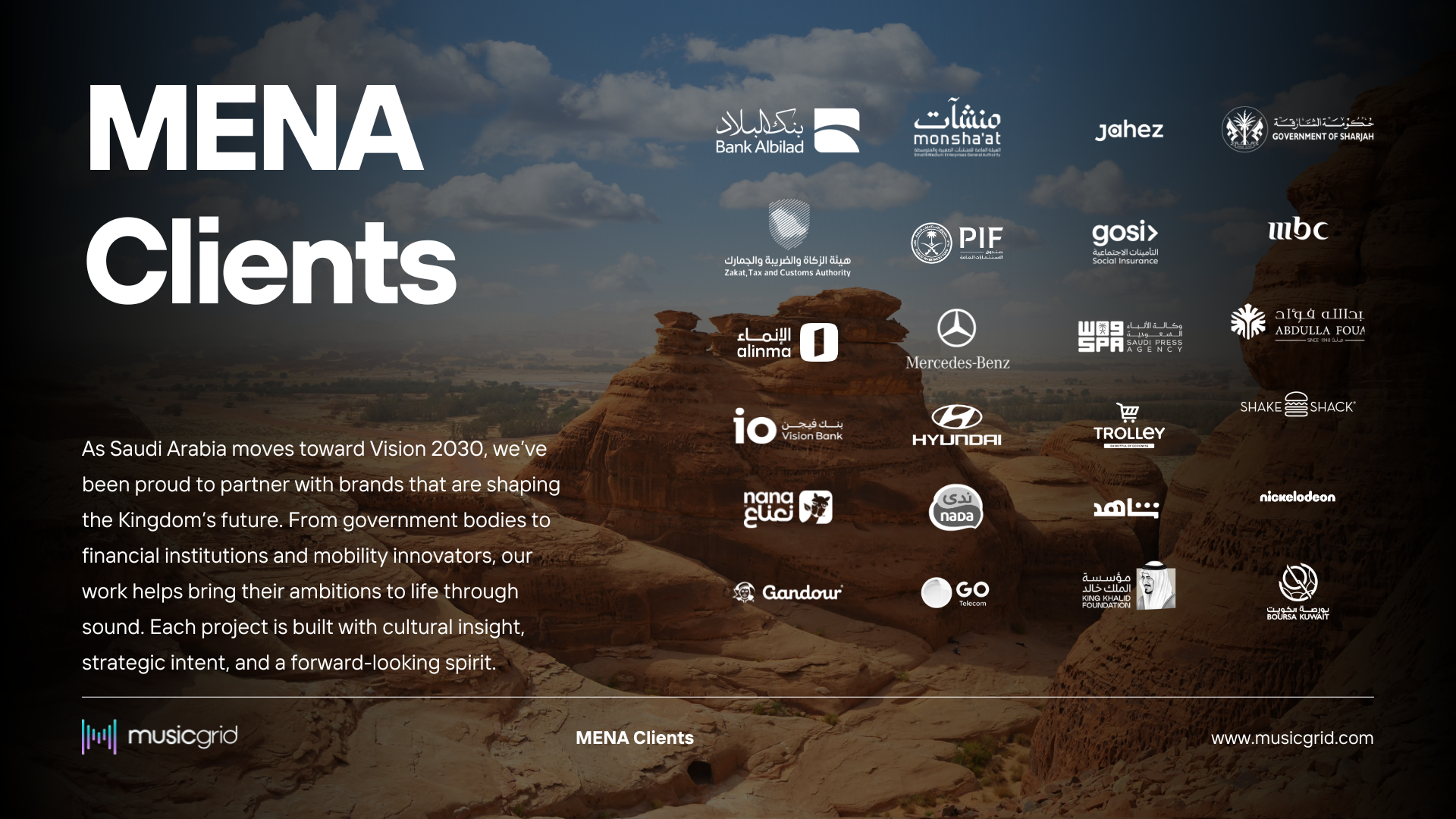
Second, emotional precision. When Bank Albilad needed music that communicated both trust and progress, or when ZATCA needed audio that felt authoritative but accessible, those briefs required interpreting abstract emotional goals into specific sonic decisions. Human composers can discuss what "trustworthy" should sound like in a Saudi banking context. AI can't participate in that dialogue or iterate based on subjective feedback.
Third, ownership and originality. Custom compositions belong entirely to the brand. No risk of another company accidentally generating similar music from the same AI prompt. No copyright claims from artists whose work was scraped into training data. No licensing restrictions if the brand wants to use the music across every market, platform, and format for the next decade. That level of control matters when sound becomes part of a brand's long-term equity.
What's Coming Next
AI music technology will keep improving. Models will improve their emotional accuracy. Copyright issues will get resolved through licensing deals like the Warner Music settlement. Costs will stay low, and generation speed will stay fast. reuters+1
But here's what won't change: brands operating in the GCC need music that sounds distinctly theirs and distinctly regional. They need composers who understand Gulf culture, audience expectations, and how to balance heritage with modernity. They need clean rights, legal clarity, and music that can carry brand equity for years, not just fill space in a single campaign.
AI can help get there faster. It can generate references, create drafts, and handle volume work. But the final composition that goes into a national Ramadan campaign or a sonic logo that plays across millions of transactions daily? That still needs human judgment, cultural expertise, and the ability to make music that doesn't just sound good but means something specific to the people hearing it.
The technology has changed how we work. It hasn't changed what great brand music requires. Speed was never the bottleneck. Emotion, culture, and originality were. Those are still human problems that need human solutions.
.png)

.svg)

.svg)
.jpg)
.jpg)
.jpg)
.jpg)
.jpg)
.jpg)
.jpg)
.jpg)
.jpg)
.jpg)
.jpg)




.jpg)



.png)
.png)
.png)
.png)
.png)
.png)
.png)
.png)
.png)
.png)
.png)
.png)
.png)
.png)
.avif)
.jpg)
.jpg)

.png)


.png)

.png)

.png)







.png)
.png)
.png)
.png)
.png)
.png)

.jpg)
.jpg)
.jpg)
.jpg)
.jpg)
.jpg)

.jpg)
.jpg)
.jpg)
.jpg)
.jpg)
.jpg)
.jpg)
.jpg)

.png)
.jpg)

.jpg)

.png)
.png)


.png)
.png)


.png)
.jpg)
.jpg)
.jpg)

.jpg)
.png)
.png)
.png)

.svg)
.svg)


.svg)
.svg)

.svg)


.svg)