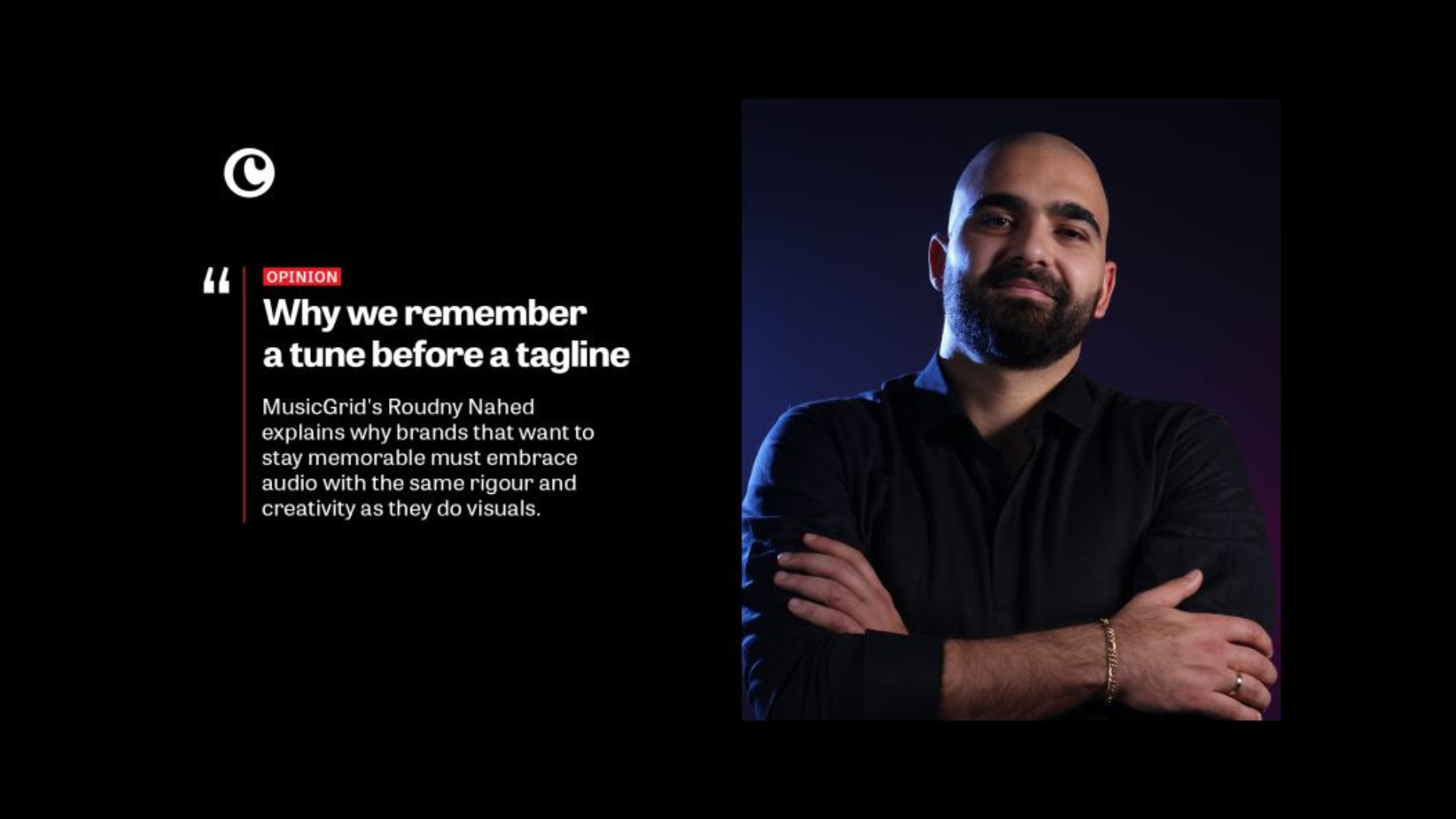
By Roudny Nahed, Partnership Manager at MusicGrid
Originally featured in Campaign Middle East
When we talk about user experience (UX), most conversations focus on what users see: layout, color, typography, motion, and interaction design. Yet one of the most powerful UX tools remains consistently overlooked: sound.
Sound design is not decorative. It is functional, psychological, and measurable. When implemented strategically, it improves usability, increases trust, reduces errors, and strengthens brand perception. When ignored, it creates friction, even in visually polished products.
Sound accelerates user response
The human brain processes sound significantly faster than visuals. Auditory signals reach the brain in as little as 20–30 milliseconds, while visual processing typically takes 200–250 milliseconds. In digital environments where speed, clarity, and confidence matter, that difference is critical.
Studies in human–computer interaction show that users respond up to 30 percent faster when audio feedback supports visual cues. This is why simple confirmation tones, progress sounds, or error alerts dramatically improve task completion.
In practical terms:
- A success sound reduces uncertainty after payments or submissions
- Error tones prevent repeated mistakes
- Progress sounds reassure users during loading states
Sound reduces hesitation, which directly improves UX efficiency.
Reducing cognitive load
Good UX is largely about minimising cognitive effort. Sound plays a major role in achieving this.
Research published in Applied Ergonomics found that multisensory interfaces reduce cognitive load by up to 23 percent compared to visual-only systems. Instead of forcing users to interpret screen changes, sound confirms outcomes instantly.
This is especially important in:
- Financial transactions
- Navigation apps
- Healthcare platforms
- Complex dashboards
Sound removes ambiguity. Users don’t need to think, they simply know.
Trust, perception, and product quality
Sound strongly influences how users judge product quality. A Google UX study showed that products with high-quality sonic design are perceived as more reliable and premium, even when visuals remain identical.
In fintech and other high-stakes digital environments, this impact is amplified. Research from PwC indicates that 32 percent of users abandon digital products after a single bad experience, with unclear or missing feedback being a common trigger. Subtle audio confirmations help prevent these moments of doubt.
Well-designed sonic cues signal:
- Stability
- Security
- Precision
Poor sound design, or silence, can do the opposite.
Error prevention and user confidence
Sound is especially powerful in preventing mistakes. In safety-critical digital systems, studies show that auditory alerts reduce user error rates by up to 34 percent compared to visual alerts alone.
This applies to everyday consumer products too:
- Confirmation sounds prevent accidental actions
- Warning tones stop failed inputs
- Escalating sounds signal urgency
These micro-interactions increase confidence and reduce frustration. Two key drivers of retention.
Accessibility is not optional
Sonic design is essential for accessibility. According to the World Health Organisation, over 2.2 billion people globally live with some form of visual impairment. Audio feedback significantly improves usability for these users.
Accessibility studies show that:
- Audio cues increase task success rates by up to 25 percent
- Sound improves navigation speed for visually impaired users
- Multisensory feedback benefits users with cognitive and attention challenges
As accessibility regulations and standards evolve, sound design is becoming a baseline requirement, not a bonus.
Sound as a branding layer
Every digital sound is a branding moment. Notification tones, interface clicks, success cues, these micro-sounds shape emotional perception over time.
Research from Ipsos shows that sonic branding increases brand recall by up to eight times compared to visual branding alone. When sonic design is consistent and intentional, it becomes part of a product’s identity.
Yet most digital products still rely on:
- Default system sounds
- Stock effects
- Inconsistent audio behavior
This represents a missed opportunity, especially in apps users interact with multiple times a day.
The cost of ignoring sound
Silence is not neutral. In UX, silence often equals uncertainty.
When users are unsure whether an action worked, they are more likely to:
- Repeat actions unnecessarily
- Abandon tasks
- Distrust the product
According to Nielsen Norman Group, lack of feedback is one of the most common usability failures in digital interfaces. Strategic sound design directly solves this problem, efficiently and intuitively.
The takeaway
Sound design is not about adding noise. It is about adding clarity.
As digital products become more complex, mobile, and immersive, sound will play an increasingly critical role in usability, accessibility, and brand perception. The most successful products already understand this and design sound as intentionally as visuals.
The best UX is not just seen. It is heard and felt.


.svg)

.svg)
.jpg)
.jpg)
.jpg)
.jpg)
.jpg)
.jpg)
.jpg)
.jpg)
.jpg)
.jpg)
.jpg)




.jpg)


.png)
.png)
.png)
.png)
.png)
.png)
.png)
.png)
.png)
.png)
.png)
.png)
.png)
.png)
.avif)
.jpg)
.jpg)
.png)
.png)



.png)

.png)

.png)







.png)
.png)
.png)
.png)
.png)
.png)

.jpg)
.jpg)
.jpg)
.jpg)
.jpg)
.jpg)

.jpg)
.jpg)
.jpg)
.jpg)
.jpg)
.jpg)
.jpg)
.jpg)

.png)
.jpg)

.jpg)

.png)
.png)


.png)
.png)


.png)
.jpg)
.jpg)
.jpg)

.jpg)
.png)
.png)
.png)

.svg)
.svg)


.svg)
.svg)

.svg)


.svg)