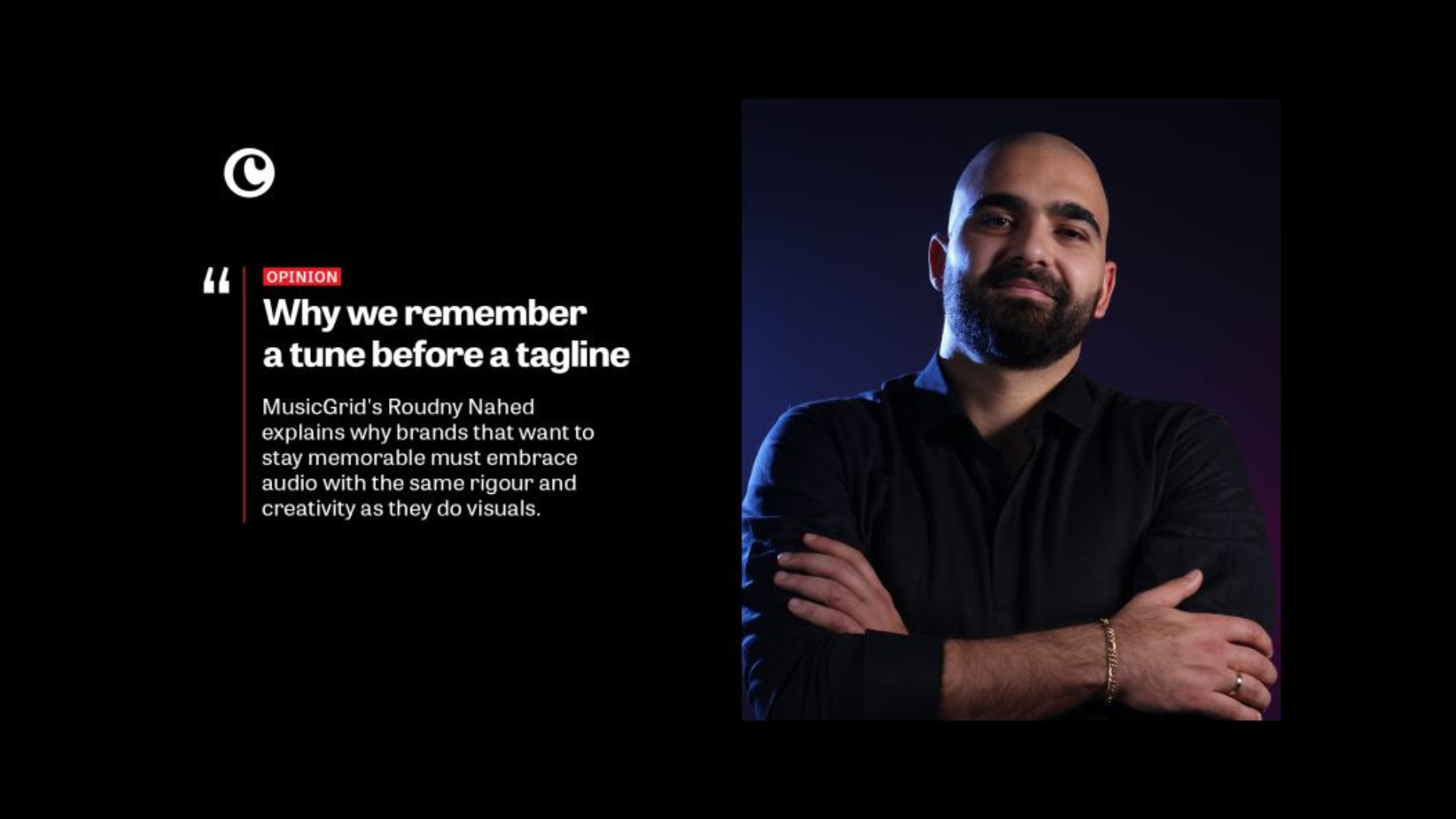
By Roudny Nahed, Partnership Manager at MusicGrid
This article was originally published by Campaign Middle East and has been adapted for MusicGrid.
Ever found yourself humming a tune from an ad you saw years ago but struggling to remember the words that came with it? You are not alone. Our brains are wired to remember melodies more easily than language, and there is a clear scientific reason why we often recall a tune long before a tagline.
In a world flooded with content, brands are competing not just for attention, but for memory. While visuals and copy dominate most brand strategies, the strongest driver of recall often lives elsewhere: sound.
How the Brain Remembers Sound
Music is processed across multiple areas of the brain at once. While text and visuals rely heavily on rational, language-based regions like the neocortex, sound activates the limbic system, which governs emotion and long-term memory.
This is why a melody can instantly trigger a feeling, a place, or a moment from years ago. Sound bypasses rational filters. It is processed faster and felt more deeply. Long before we learn to read or speak, we respond to rhythm, tone, and melody. Music connects with us on a primal level.
This neurological advantage is what makes sonic branding such a powerful memory tool. The brain is simply better at storing and recalling sound.
Earworms and Brand Recall
Psychologists use the term “earworm” to describe a piece of music that gets stuck in your head. These loops are not accidental. They are powerful memory mechanisms.
Think of the Intel sound. Five simple notes, instantly recognizable worldwide. Or McDonald’s “I’m Lovin’ It,” a short musical phrase that embedded itself into global culture. Many people cannot quote the official taglines of these brands, but they can recognize the sound in a fraction of a second.
These sonic identities were not created by chance. They were designed to be simple, distinctive, and emotionally resonant. Over time, they build a shortcut between the brand and a feeling, whether that feeling is trust, joy, energy, or familiarity.
The Cost of Ignoring Sound
Despite the evidence, many brands still treat audio as an afterthought. They invest heavily in logos, typography, and color systems, but rely on stock music or inconsistent sound choices across campaigns and platforms.
The result is a gap. A brand may look strong but feel forgettable. In a multi-platform world where consumers interact with brands through video, social media, apps, podcasts, and customer service touchpoints, that inconsistency becomes a missed opportunity.
More importantly, it becomes a vulnerability. When a competitor invests in a cohesive sonic identity, they begin to own emotional territory that others leave unclaimed.
Consistency Across Touchpoints
When done properly, sonic branding scales seamlessly. A single sound identity can live across advertising, digital products, customer experience, and physical spaces.
It also allows brands to exist in non-visual environments. Voice assistants, podcasts, smart speakers, and audio-first platforms are growing rapidly. A brand that can be recognized without being seen gains a significant advantage.
In short-form video and fast-scroll environments, sound often reaches the brain before the logo does. A familiar audio cue can trigger recognition in seconds.
Music as an Emotional Multiplier
Sound does more than improve recall. It amplifies emotion.
A tagline explains what a brand stands for. Music makes you feel it. When sound is integrated into storytelling, it strengthens every message. It enhances excitement in a product launch, tension in a campaign, or pride in a national moment.
Some of the most memorable brand campaigns in history are remembered as much for their music as for their visuals. That is not coincidence. Music turns messaging into meaning.
Why Sonic Identity Is Now Essential
Attention is fragmented. Screens are saturated. Competition for mental space is intense. In this environment, sound is no longer a creative extra. It is a strategic necessity.
Brands that want to stay memorable must approach audio with the same rigor and creativity they apply to visual identity. That means developing a distinct sonic identity, being intentional about sound across every touchpoint, and treating music as a long-term brand asset rather than a temporary layer.
The brands of the future will not only be seen.
They will be heard.
And remembered.
By Roudny Nahed, Partnership Manager at MusicGrid

.svg)

.svg)
.jpg)
.jpg)
.jpg)
.jpg)
.jpg)
.jpg)
.jpg)
.jpg)
.jpg)
.jpg)
.jpg)
.jpg)
.jpg)




.jpg)


.png)
.png)
.png)
.png)
.png)
.png)
.png)
.png)
.png)
.png)
.png)
.png)
.png)
.png)
.avif)
.jpg)
.jpg)

.png)
.png)



.png)

.png)

.png)








.png)
.png)
.png)
.png)
.png)
.png)
.jpg)
.jpg)
.jpg)
.jpg)
.jpg)
.jpg)

.jpg)
.jpg)
.jpg)
.jpg)
.jpg)
.jpg)
.jpg)
.jpg)

.png)
.jpg)

.jpg)

.png)
.png)


.png)
.png)


.png)
.jpg)
.jpg)
.jpg)

.jpg)
.png)

.svg)
.svg)


.svg)
.svg)

.svg)


.svg)