Saudi Arabia will host the 2034 FIFA World Cup. That fact is confirmed, the infrastructure is moving, and the global attention that comes with it is already building. While the world watches the 2026 tournament unfold across North America, Saudi brands operating in tourism, finance, government, retail, and the giga-project space are facing a question most have not yet addressed with the seriousness it deserves.
What will your brand sound like when the world arrives?
This is not a rhetorical question. Eight years sounds like a distance. It is not. And the brands that will be sonically ready for 2034 are the ones that start making deliberate decisions about their audio identity today.
Why 2034 Is a Sonic Branding Deadline, Not a Future Opportunity
Every major global sporting event produces a concentrated period during which the host country's brands are subjected to international scrutiny that they do not experience at any other time. Billions of people watch. International media, sponsors, broadcasters, and travelers encounter the destination through every available channel, and audio is present in all of them.
Stadium sound. Broadcast themes. Destination campaigns are running across global platforms. Tourism brand audio at airports and hotels. Sponsor activations with their sonic signatures woven across every touchpoint. The ambient audio of cities, venues, and transport infrastructure.
All of it adds up to a sonic picture of Saudi Arabia that will be experienced by a global audience in 2034. Some of that picture will be deliberately designed. The parts that are not will fill themselves in with whatever is available, which usually means generic, forgettable sound.
The brands that want to be well represented in that picture need to build their sonic identity now, deploy it consistently over the years between now and 2034, and arrive at that moment with an audio asset that has genuine recognition value.
Building recognition takes time. That is not a creative problem. It is a neurological one.
The Math Behind Sonic Equity
A professional sonic identity takes five to six months to build from strategy through full implementation. That is the process: discovery workshops, brand strategy, musical direction, concept development, production, touchpoint adaptation, guidelines, and rollout. Done properly, it takes roughly half a year.
But the identity does not have value on the day it launches. It has value after it has been heard thousands of times, across multiple contexts, by the same audiences who will eventually recognize it without thinking.
Research published in the Journal of Consumer Research shows that audio stimuli remain active in memory for nearly five seconds before fading. Visual elements fade in milliseconds. That extended retention window is the mechanism through which consistent audio builds brand equity. Every time your brand sounds like itself, the memory trace deepens. The more times a customer has heard your sonic identity before a major brand moment, the stronger the recognition when that moment arrives.
Intel's five-note sonic logo represents an estimated $200 million in brand value. That figure was not produced in five years. It was produced by 22 years of consistent deployment across billions of customer interactions.
Saudi brands have eight years before the 2034 World Cup. That is enough time to build genuinely significant sonic equity, provided the work starts now. Brands that commission their sonic identity in 2032 will launch into 2034 with an asset that has been deployed for 2 years. Brands that start today will arrive at 2034 with eight years of compounding recognition.
The gap between those two positions is not a styling difference. It is a fundamental strategic advantage.
Which Saudi Brands Have the Most at Stake
Giga-Project Brands
NEOM, Diriyah, Qiddiya, the Red Sea Project, and every other major destination brand being built under Vision 2030 will face a scale of international visitor exposure in 2034 that no domestic launch campaign can produce.
These brands are investing billions in architecture, hospitality, and visitor experience. Many have visual identities that reflect serious investment in world-class design thinking. The question is whether those visual identities have a sonic counterpart, and whether that sound will be ready when the global spotlight is on.
A giga-project destination brand without a sonic identity in 2034 has missed the most important audio moment in its history.
Saudi Tourism Brands
Saudi Arabia's inbound tourism numbers are growing significantly year on year as Vision 2030 tourism targets drive investment in infrastructure and marketing. The 2034 World Cup is the single largest promotional moment for Saudi tourism in modern history. International visitors will experience Saudi hospitality brands, airlines, airports, hotels, and destination operators through all their senses, including sound.
Tourism brands with a coherent, culturally authentic sonic identity in 2034 will deliver a more memorable experience and a stronger impression of the Kingdom as a world-class destination.
National and Government-Owned Enterprises
Government entities, semi-government brands, and national institutions will be prominent throughout the 2034 event. Whether that means financial institutions facilitating transactions for international visitors, telecommunications operators running the digital infrastructure, or transport brands moving 48 teams and millions of fans across the country, each of these organizations will be communicating with an international audience at scale.
That communication happens through every touchpoint. If your brand's contact center, mobile app, ATM, and broadcast advertising all share a deliberate, culturally grounded sonic identity, the experience adds up. If they do not, the experience is inconsistent, and an inconsistent brand experience at scale is a measurable cost.
Saudi Sponsorship Brands
Saudi brands entering global or tournament-level sponsorships between now and 2034 will need audio assets that perform at the level of the broadcast context they are buying into. A sponsorship that runs a campaign across a global platform without a recognizable sonic signature leaves recognition value on the table.
GCC brands that have invested in sonic identity report that their advertising performs measurably better, precisely because the audio element carries recognition from campaign to campaign rather than starting from scratch each time.
What Vision 2030 Has Already Established
Saudi Arabia's transformation is not a future narrative. It is a reality, and it has implications for how Saudi brands should sound.
Vision 2030 is producing a new generation of Saudi enterprises, government entities, and destination brands that are positioning themselves for both domestic audiences and international ones. That dual positioning creates a specific sonic branding challenge: the identity needs to carry genuine Saudi cultural weight while communicating with the fluency and confidence that a global audience expects from a world-class brand.
Generic international production does not solve that challenge. A sonic identity that relies on surface-level Arabic instrumentation over a Western arrangement does not solve it either. What solves it is a sound built on a genuine understanding of Saudi musical heritage, maqam tonality, regional rhythmic traditions, and contemporary production standards, assembled through a strategic process that connects the audio choices directly to the brand's positioning.
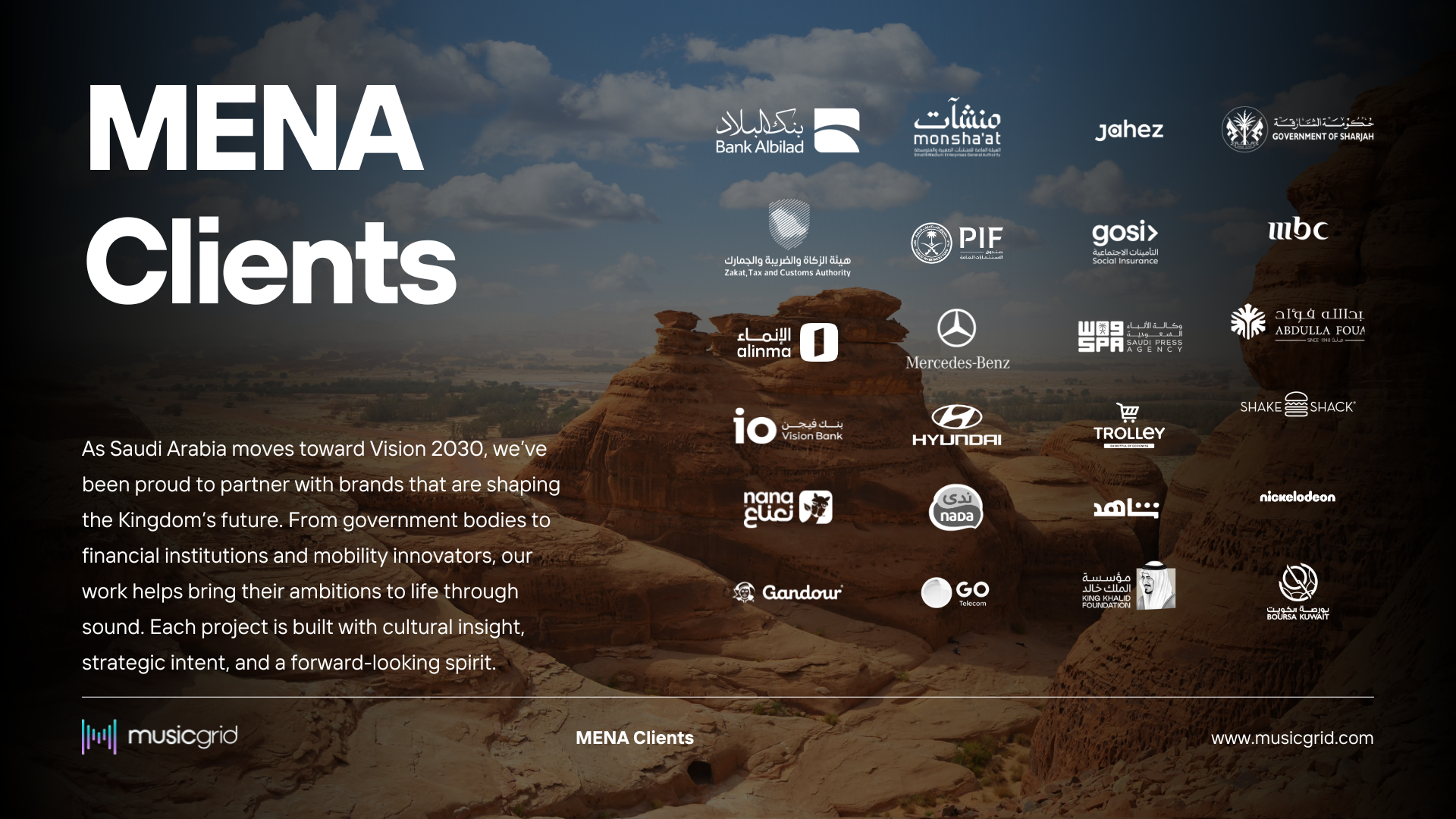
MusicGrid's work with Saudi organizations, including Bank Albilad, ZATCA, Monsha'at, and Nada Dairy, reflects exactly that approach. Each of those identities sounds unmistakably Saudi without sounding dated or regionally isolated. They carry cultural authenticity and international credibility simultaneously. That balance is what a 2034-ready Saudi brand needs in its audio identity.
The Specific Assets a Saudi Brand Needs Before 2034
A Sonic Logo That Travels
Your sonic logo is the three- to five-second audio signature that appears at the end of advertising, across your digital interfaces, and in every broadcast context where your brand is present. It is the most compressed, most recognizable expression of your brand's audio identity.
By 2034, your sonic logo should have been heard enough times across enough contexts that an international visitor or viewer encounters it with a sense of recognition, even if they cannot name the brand explicitly. That level of recognition takes years to build. The sonic logo you commission today is the one you need to be deploying consistently from the moment it launches.
A Brand Theme With Cultural Depth
The full brand theme is the extended musical expression of your identity, used in longer advertising, events, activations, and broadcast moments. For Saudi brands in 2034, the brand theme is also a statement about Saudi culture to an international audience.
A brand theme with genuine cultural depth, built around traditional Saudi musical elements combined with world-class contemporary production, conveys something about the Kingdom that no single visual element can. Music reaches people emotionally and directly. A well-designed Saudi brand theme in 2034 tells the country's story through sound in a way no brand campaign narration does as efficiently.
A Spatial and Environmental Audio System
The 2034 World Cup will bring millions of people into physical spaces in Saudi Arabia: stadiums, hotels, airports, shopping destinations, entertainment venues, and giga-project sites. Each of those spaces has audio. The question is whether that audio is part of a coherent brand experience or a collection of unrelated playlist decisions.
Retail brands using strategic environmental audio see measurable improvements in dwell time, purchase intent, and brand perception. For Saudi destination brands in 2034, the physical audio environment is a primary point of differentiation. Visitors who leave Saudi Arabia with a positive emotional memory of how it sounded, not just how it looked, will become advocates for the destination in ways that no paid campaign can produce.
IVR, App, and Digital Touchpoint Audio
International visitors in 2034 will interact with Saudi brands through apps, websites, call centers, and digital interfaces at a scale that exceeds any previous tourism season. Each of those interactions includes audio. Transaction confirmations. Hold music. App notification sounds. UI feedback.
None of those audio moments is neutral. Each one either reinforces the brand or contradicts it. Building the digital audio layer into the sonic identity system before 2034 ensures that the brand experience is consistent across the full range of touchpoints an international visitor encounters.
The Cost of Waiting
Brands that wait until 2032 or 2033 to consider their sonic identity will face several problems simultaneously.
First, they will be commissioning their audio work during a period of extremely high demand. As 2034 approaches, every Saudi brand that has not yet acted will act at the same time. The agencies and studios with genuine strategic capability will be fully committed. The work that gets done under those conditions is production, not strategy.
Second, they will be launching a new sonic identity with almost no deployment history. The research on sonic branding is direct: recognition requires repetition, and repetition requires time. An identity launched in 2033 will have at best 12 months of deployment before the World Cup. An identity launched in 2026 will be eight years old.
Third, they will have missed every opportunity between now and 2034 to build the recognition that makes a brand valuable in a high-attention moment. Every Ramadan campaign, every National Day activation, every advertising flight, and every digital interaction between now and 2034 is a compounding opportunity. Brands that have a sonic identity in place will build recognition across all of them. Brands that do not will be starting from zero when the moment arrives.
According to the SoundOut Index 2025, sonic branding is now ranked as the single most effective driver of brand awareness, ahead of visual identity for recall in audio-rich environments. That finding applies more sharply to Saudi brands today than it will to any brand in any context in 2034, because today is when the building happens.
What Readiness Actually Looks Like
A Saudi brand that is sonically ready for 2034 has an instantly recognizable sonic logo. It has a brand theme that carries cultural depth and production quality appropriate to international broadcast. It has touchpoint audio covering digital, spatial, and telephony contexts. It has seasonal adaptations for Ramadan, National Day, and Eid already built into the system. And it has years of consistent deployment behind the identity by the time the global spotlight arrives.
That is not an ambitious aspiration. It is a standard that is achievable today for any Saudi enterprise that decides to treat audio as the brand asset it is.
The brands that will represent Saudi Arabia best in 2034 are making that decision now. Brands waiting for a clearer picture of what 2034 will look like are simply allowing the gap to widen.
If you are ready to understand what a complete sonic identity would look like for your brand, start with a strategy conversation.
Talk to MusicGrid
Frequently Asked Questions
Why does a Saudi brand need a sonic identity before the 2034 World Cup?
The 2034 FIFA World Cup will put Saudi brands in front of a global audience at a scale they have never experienced before. Audio is present at every touchpoint: advertising, apps, venues, contact centers, and broadcast media. Brands that have built a recognized sonic identity before the event will benefit from years of compounding recognition. Brands that have not will be introducing their sound to a global audience at the same time they are trying to make a strong first impression.
How long does it take to build a sonic identity for a Saudi brand?
A professionally developed sonic identity takes five to six months from strategy workshops through full implementation. However, the recognition value of a sonic identity grows with consistent deployment over time. A brand that launches its sonic identity in 2026 and deploys it consistently across eight years of campaigns, touchpoints, and seasonal moments will arrive at 2034 with substantially stronger audio recognition than a brand that launches in 2033.
What is sonic branding, and how does it apply to Saudi Arabia's Vision 2030?
Sonic branding is the strategic design of audio assets that represent a brand's identity, including sonic logos, brand themes, UI sounds, environmental music, and IVR audio. For Saudi brands under Vision 2030, sonic branding is part of building a world-class brand presence capable of competing internationally. As Saudi Arabia positions itself as a global destination for tourism, investment, and business, the brands that represent the Kingdom need audio identities that carry both cultural authenticity and international credibility.
What Saudi brands should invest in sonic branding before 2034?
The sectors with the most at stake are giga-project destination brands, national tourism brands, financial institutions serving international visitors, telecommunications operators, transport brands, and any Saudi enterprise with international sponsorship commitments between now and 2034. Government entities and semi-governmental organizations that will be prominently visible during the tournament also benefit significantly from having a coherent, culturally grounded sonic identity.
How does sonic branding help Saudi brands compete internationally?
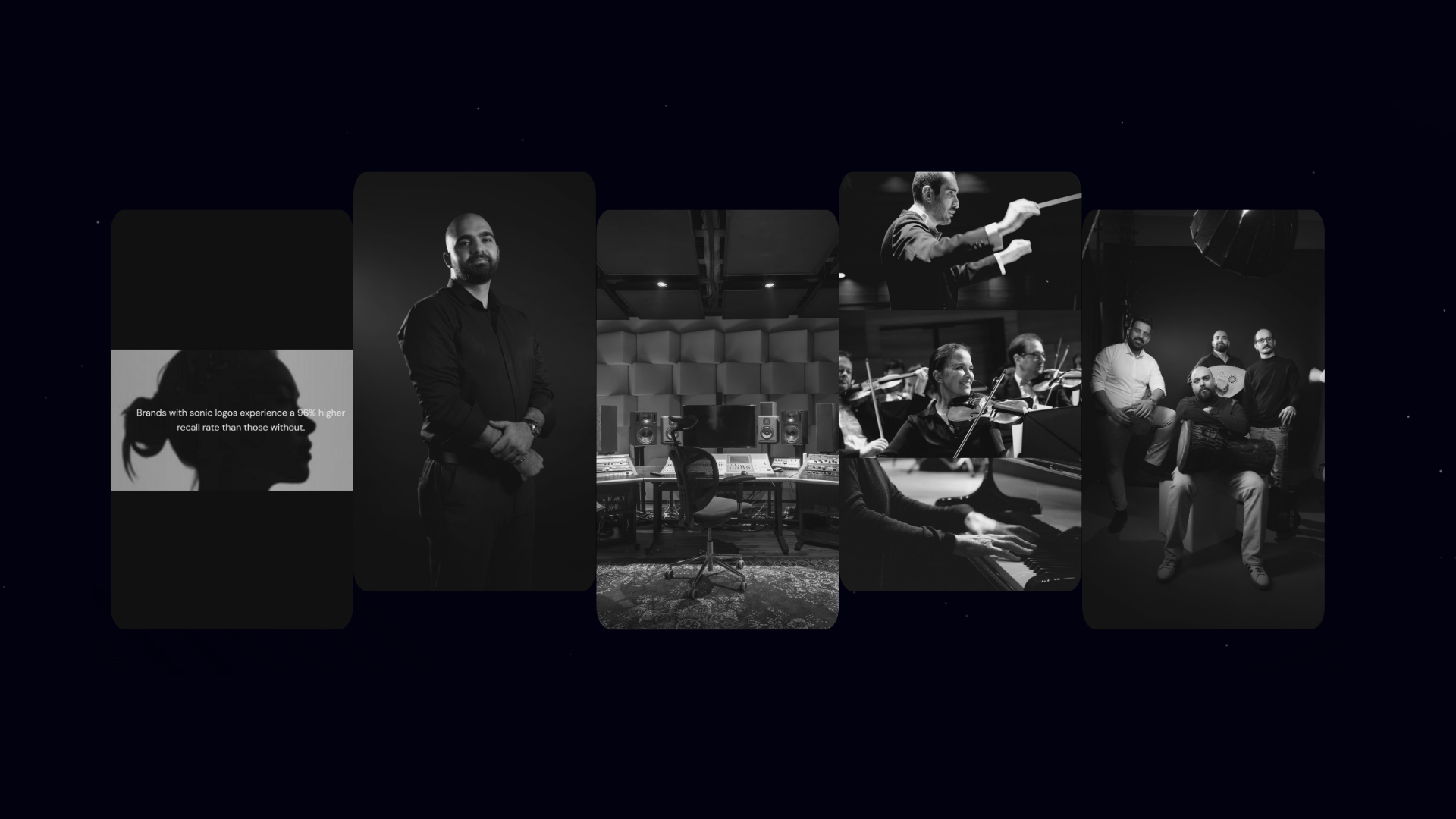
Research shows that audio branding improves brand recall by 96% compared to visual-only branding. Consistent sonic identity across touchpoints builds memory associations that make brands easier to recall at the moment of purchase or decision. For Saudi brands competing for international attention, a sonic identity that conveys genuine Saudi cultural depth while meeting world-class production standards communicates both authenticity and ambition in ways that visual identity alone cannot.
What is included in a complete sonic identity for a Saudi enterprise brand?
A complete sonic identity includes a sonic logo for instant recognition across advertising and digital touchpoints, a full brand theme for longer brand moments and campaign activations, seasonal adaptations for Ramadan, National Day, and Eid, functional UI and app audio, environmental and spatial audio for physical locations, IVR and contact center audio, and usage guidelines that ensure consistent deployment across all teams and agencies.


.svg)

.svg)
.jpg)
.jpg)
.jpg)
.jpg)
.jpg)
.jpg)
.jpg)
.jpg)
.jpg)
.jpg)
.jpg)
.jpg)
.jpg)



.jpg)



.png)
.png)
.png)
.png)
.png)
.png)
.png)
.png)
.png)
.png)
.png)
.png)
.png)
.png)
.avif)
.jpg)
.jpg)
.png)
.png)
.png)

.png)

.png)







.png)
.png)
.png)
.png)
.png)
.png)
.jpg)
.jpg)
.jpg)
.jpg)
.jpg)
.jpg)

.jpg)
.jpg)
.jpg)
.jpg)
.jpg)
.jpg)
.jpg)
.jpg)

.png)
.jpg)

.jpg)

.png)
.png)


.png)
.png)


.png)
.jpg)
.jpg)
.jpg)

.jpg)
.png)

.svg)
.svg)


.svg)
.svg)

.svg)


.svg)