Some advertising messages are heard once and quickly forgotten.
Others stay in the audience’s mind long after the campaign ends.
A strong advertising jingle can turn a brand name, product benefit or campaign message into a memorable piece of music. Instead of relying only on spoken words, it uses melody and repetition to make the message easier to recognize and recall.
For brands in Saudi Arabia, jingles can be particularly effective during product launches, retail campaigns, Ramadan, Saudi National Day and other moments that require broad audience reach.
However, not every campaign needs one.
The decision should depend on what the campaign needs audiences to remember, how the music will be used and whether the concept fits the brand.
What Is an Advertising Jingle?
An advertising jingle is a short, original piece of music created around a brand or campaign message.
It usually includes lyrics and may communicate:
- The brand name
- A product name
- A slogan
- A campaign message
- A product benefit
- A call to action
- A promotional offer
Some jingles function like short songs. Others may contain only a few sung words placed over a simple melody.
The defining feature is that the verbal message and music are designed together.
This differs from a conventional campaign soundtrack, which may support the emotion and story without directly singing the brand’s message.
Why Can Jingles Be So Memorable?
Music gives words structure.
When a phrase is connected to a clear melody and rhythm, it can become easier to remember than the same phrase spoken normally.
This is why people can often recall advertising songs from years earlier, even when they have not seen the original commercial recently.
A jingle can support memory through:
- Repetition
- A simple melody
- A predictable rhythm
- Rhyme
- A distinctive vocal performance
- Clear association with the brand
- Consistent use across the campaign
However, repetition alone does not guarantee memorability.
If the melody is generic, the lyrics are complicated or the brand name feels forced into the music, the jingle may become irritating rather than effective.
The strongest jingles make the message feel natural and enjoyable to repeat.
When Should a Brand Use a Jingle?
Jingles are most effective when the campaign has a simple message that audiences should remember.
This may include the launch of a new product, a promotional campaign, a new slogan or a specific product benefit.
A jingle may be particularly suitable when:
- The brand name needs greater awareness
- The product name is central to the campaign
- The slogan is short and repeatable
- The campaign will receive frequent exposure
- The audience is broad
- The tone is energetic, warm or entertaining
- Several short advertising formats are required
- The brand wants the campaign to encourage participation
- The music may extend into social or influencer content
Retail, food and beverage, telecommunications, entertainment and consumer-service brands may benefit from this approach because their campaigns often communicate direct and repeatable messages.
A jingle can also work for government and corporate organizations when the tone and message are appropriate. It does not always need to sound playful or commercial.
When Is a Jingle the Wrong Choice?
A jingle should not be used simply because the campaign needs music.
Some stories require emotional space rather than a repeated verbal message.
A cinematic brand film, serious public-awareness campaign or premium corporate communication may be better served by an instrumental soundtrack or an original song with less direct branding.
A jingle may be unsuitable when:
- The message is too complicated
- The campaign requires a serious or restrained tone
- The brand name does not fit naturally into lyrics
- The advertisement already contains heavy dialogue
- The campaign will receive very limited exposure
- The brand is uncomfortable with direct repetition
- The creative concept depends on subtlety
- The music is not central to the communication
The format should support the campaign idea.
Trying to force every message into a catchy song can weaken both the music and the advertisement.
Start With the Message
Before writing the melody, the team should decide exactly what audiences need to remember.
A jingle cannot communicate every feature, benefit and campaign objective at once.
The message should usually be reduced to one central idea.
This could be:
- The brand name
- A campaign slogan
- A new product
- A functional benefit
- A simple emotional promise
- A short call to action
For example, a restaurant campaign may focus on the product name and an expression of enjoyment. A telecommunications campaign may emphasize speed or connection. A retail campaign may highlight convenience or value.
The clearer the message, the easier it becomes to create a memorable musical phrase around it.
Keep the Lyrics Simple
Advertising lyrics need to communicate quickly.
Unlike a full song, the audience may hear the jingle only briefly and without actively paying attention.
The lyrics should therefore be easy to understand on the first listen.
Effective jingle lyrics are usually:
- Short
- Conversational
- Rhythmically clear
- Easy to pronounce
- Easy to repeat
- Connected to the campaign
- Natural in the intended language
Too many words can make the jingle feel rushed.
A simple phrase repeated effectively is often more memorable than several lines explaining the product.
The lyrics should also sound natural when sung. A slogan that works well in written advertising may require small adjustments before it fits comfortably into a melody.
Write the Brand Name Naturally Into the Music
Including the brand name can strengthen association, but it must feel musical.
If the pronunciation is awkward or the emphasis falls on the wrong syllable, the jingle may sound forced.
The composer should consider:
- The number of syllables
- The natural spoken emphasis
- The pronunciation in Arabic and English
- Whether the name is normally shortened
- How the final syllable connects to the next word
- Whether the name should appear once or several times
This is especially important for regional campaigns involving Arabic and English versions.
The same brand name may sit differently within each language. The surrounding lyrics or rhythm may need to change while the core melody remains recognizable.
Create a Strong Melodic Hook
The melodic hook is the part of the jingle audiences are most likely to remember.
It should be distinctive enough to stand out but simple enough to repeat.
A strong hook often uses:
- A short group of notes
- A clear rhythm
- Repetition
- A satisfying ending
- A comfortable vocal range
- One recognizable musical feature
More notes do not necessarily make a melody more memorable.
Complicated melodies can be difficult for audiences to recall or sing back. A shorter and more focused idea often creates a stronger result.
The hook should also remain recognizable when heard outside the full commercial.
This allows it to work in short social advertisements, radio spots and other campaign applications.
Match the Style to the Brand
A catchy jingle still needs to sound like the brand.
The musical style should be based on the brand’s personality, audience and campaign concept rather than current trends alone.
A youth-focused application may require contemporary electronic production. A family food brand may want something warm, energetic and familiar. A premium real estate campaign may use a more refined and cinematic approach.
The direction may be:
- Playful
- Emotional
- Celebratory
- Premium
- Energetic
- Traditional
- Contemporary
- Humorous
- Inspirational
The jingle should attract attention without making the brand feel like something it is not.
This is why the process should begin with a clear creative and musical brief.
Create Cultural Relevance With Purpose
A Saudi advertising jingle does not automatically need an oud, ney or traditional percussion.
Cultural elements should support the message and occasion.
For a Saudi National Day campaign, regional instrumentation, rhythms or vocal styles may play a central role. For a modern digital product, Saudi relevance may be communicated more subtly through language, melodic phrasing or performance.
Cultural influence can appear through:
- Rhythm
- Melody
- Musical scale
- Instrumentation
- Vocal delivery
- Dialect
- Lyrical references
- Group singing
- Production style
The objective is not to add as many regional sounds as possible.
It is to create music that feels natural for the specific brand, audience and campaign.
Decide Between Arabic, English and Bilingual Versions
Many campaigns in Saudi Arabia and the GCC require both Arabic and English content.
A jingle written in one language cannot always be translated word for word.
Arabic and English have different sentence structures, syllable counts and rhythmic patterns. A direct translation may preserve the meaning but feel unnatural when sung.
Brands may choose to create:
- A primary Arabic jingle
- A primary English jingle
- Separate Arabic and English versions
- A bilingual version
- One common hook with different verses
- A nonverbal vocal hook
- An instrumental version
If both languages are important, they should be considered at the beginning of the writing process.
This gives the composer and lyricist enough flexibility to protect the meaning, musical flow and brand recognition in each version.
Choose the Right Vocalist
The vocalist becomes part of how the brand is perceived.
A youthful voice creates a different impression from a mature or authoritative one. A solo vocal feels different from a group performance.
The choice may depend on:
- The intended audience
- The brand’s personality
- The campaign story
- The required language or dialect
- The energy of the music
- Whether the voice should feel polished or natural
- Whether the campaign requires a recognizable artist
A professional singer may provide technical control and consistency. In other cases, a less polished voice may feel more human and relatable.
The performance should express the campaign’s character, not simply demonstrate vocal ability.
Consider an Artist Partnership
Some campaigns may benefit from involving a recognized singer or artist.
An artist can bring cultural relevance, an existing audience and a distinct creative personality to the campaign.
This approach may work well when:
- The campaign is a major launch
- Entertainment is central to the concept
- The artist genuinely fits the brand
- Social reach is important
- The music will be released beyond the commercial
- The campaign requires audience participation
However, the artist should not overshadow the brand.
The agreement must also clarify usage rights, media, territories, duration, exclusivity and whether the artist’s name and image can be used in promotion.
For some campaigns, an original vocalist created around the brand may provide greater flexibility and long-term usability.
Compose the Jingle Around the Film
When the jingle is part of a television commercial or digital film, it should be written around the edit.
The music may need to support:
- The opening hook
- Product demonstrations
- Scene changes
- On-screen text
- Dialogue
- The main campaign message
- The product reveal
- The final logo appearance
- The call to action
The jingle should leave enough space for important dialogue and sound design.
If every second contains vocals, the advertisement can become difficult to understand. Instrumental sections or shorter vocal phrases can create space for the story.
MusicGrid creates original advertising music and campaign soundtracks around the exact timing, message and creative direction of each film.
Design It for Short-Form Content
Many campaigns are now experienced through short social advertisements rather than only a full television commercial.
The jingle should therefore work in several durations.
A campaign may require:
- A full-length version
- A 30-second version
- A 15-second version
- A six-second version
- Social media cutdowns
- Radio versions
- Instrumental versions
- Creator and influencer versions
- Audio-only clips
The most recognizable line should appear quickly enough to work in short formats.
If the hook only arrives after 25 seconds, it may disappear completely from the campaign’s shorter edits.
Planning the structure early allows each version to feel intentional rather than abruptly shortened.
Make the Jingle Flexible
A well-designed jingle can appear in different styles without losing its identity.
The same melody might become:
- A full vocal song
- A short sung brand line
- An instrumental campaign soundtrack
- A social media sound
- A radio mnemonic
- An event performance
- A seasonal adaptation
- A sonic logo
This flexibility increases the value of the original music.
It also allows the campaign to remain consistent without repeating exactly the same recording everywhere.
Connect the Jingle to the Sonic Identity
A campaign jingle and a sonic identity are not the same thing.
A jingle is generally created around a specific verbal message or campaign. A sonic identity is a wider system that defines how the brand sounds across different touchpoints and over time.
However, the two can be connected.
If the brand already has a sonic logo or core melody, it may be integrated into the jingle. Alternatively, a memorable musical phrase from a successful jingle may sometimes inspire future brand assets.
The connection could appear through:
- A shared melody
- The sonic logo at the end
- A recognizable rhythm
- Consistent instrumentation
- A familiar vocal phrase
- A common musical ending
This helps the campaign build the brand’s long-term recognition rather than creating an isolated sound.
Test Whether It Is Memorable and Appropriate
Internal teams may approve a jingle because they personally enjoy it.
Audience testing can provide a more useful perspective.
Research may explore:
- Whether people remember the melody
- Whether they remember the correct words
- Whether they identify the brand
- Whether the tone fits the organization
- Whether the message is understood
- Whether the jingle becomes irritating after repetition
- Whether it feels culturally appropriate
- Whether it is distinctive from competitors
The most popular musical option is not automatically the best.
The jingle needs to perform its intended role: communicating the message and strengthening recognition for the correct brand.
Clarify Music and Performer Rights
An original jingle may involve several different rights.
These can include rights related to:
- The musical composition
- The lyrics
- The master recording
- The vocalist
- Additional musicians
- Adaptations and edits
- Media and platforms
- Campaign duration
- Countries and territories
- Future use
- Artist name and image
The agreement should explain whether the brand owns the music or receives a licence to use it.
It should also clarify whether the brand and its agencies can shorten, remix, translate or adapt the jingle later.
Clear rights are particularly important if the campaign may expand across multiple GCC markets or continue for several years.
Deliver More Than One Final File
The final delivery package should reflect how the campaign will actually be used.
Depending on the scope, brands may require:
- Full vocal master
- Instrumental master
- Music-only version
- Versions without lead vocals
- Arabic and English versions
- 30-second and 15-second edits
- Six-second hooks
- Radio versions
- Separate musical stems
- Alternative endings
- Sonic-logo endings
- Broadcast WAV files
- Digital audio files
Stems separate elements such as vocals, melody, percussion and bass.
They allow agencies to adjust the balance under voice-over, create shorter versions and adapt the music for future applications.
Measure More Than Campaign Views
Views and engagement can show how widely a campaign was experienced, but they do not reveal whether the jingle strengthened the brand.
Brands can also evaluate:
- Message recall
- Brand-name recall
- Correct brand attribution
- Melody recognition
- Campaign awareness
- Audience sentiment
- Search interest
- Social participation
- Continued recognition after the campaign
A successful jingle should not only attract attention while the advertisement is running.
It should help audiences remember the brand and message afterward.
Frequently Asked Questions
- What is an advertising jingle? An advertising jingle is a short original song or sung musical phrase created around a brand name, slogan, product or campaign message.
- How long should a jingle be? There is no fixed length. A complete advertising jingle may last 15 to 60 seconds, while its main hook may be only a few seconds long.
- Does every jingle need lyrics? Traditionally, jingles include words. However, a campaign can also use a nonverbal vocal hook or short instrumental mnemonic when lyrics are unnecessary.
- Should a Saudi advertising jingle use traditional music? Not necessarily. Cultural elements should be used when they support the brand, audience and campaign concept. The direction may be traditional, contemporary or a combination of both.
- Can one jingle work in Arabic and English? Yes, but direct translation may not fit the same melody naturally. Separate lyrical arrangements may be required for each language.
- What is the difference between a jingle and a sonic logo? A jingle usually communicates a verbal campaign message through music. A sonic logo is a very short and primarily nonverbal brand identifier designed for repeated use.
- Can a jingle become part of a sonic identity? Yes. Its melody, rhythm or vocal hook may be incorporated into wider brand assets when it is suitable for long-term use.
- Does the brand own an original jingle? That depends on the agreement. Ownership, licensing, performer rights, territories, media and adaptation rights should be clarified before production begins.
Creating a Jingle People Remember
A successful advertising jingle is not simply a catchy song.
It translates a clear campaign message into a memorable musical idea that feels natural for the brand and audience.
For brands in Saudi Arabia, this requires the right balance of clear lyrics, cultural understanding, strong composition, appropriate vocals and flexibility across television, radio and short-form digital content.
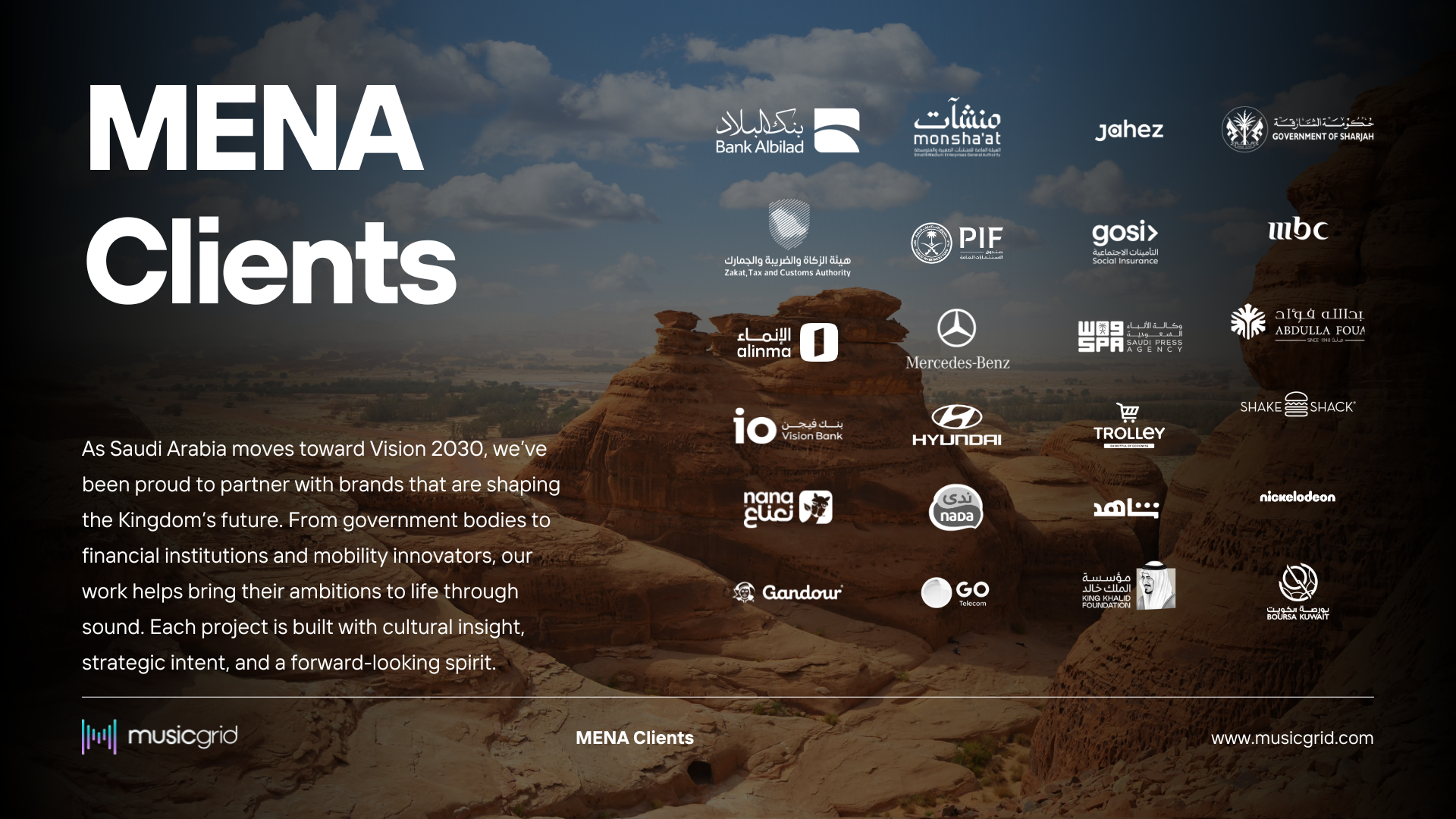
MusicGrid creates original jingles, advertising music and campaign soundtracks for brands across Saudi Arabia, the GCC and the wider MENA region.
Contact MusicGrid to create an original jingle for your next campaign.
.jpg)

.svg)

.svg)
.jpg)
.jpg)
.jpg)
.jpg)
.jpg)
.jpg)
.jpg)
.jpg)
.jpg)
.jpg)
.jpg)
.jpg)
.jpg)
.jpg)




.jpg)



.png)
.png)
.png)
.png)
.png)
.png)
.png)
.png)
.png)
.png)
.png)
.png)
.png)
.png)
.avif)
.jpg)
.jpg)

.png)
.png)
.png)
.png)

.png)








.png)
.png)
.png)
.png)
.png)
.png)
.jpg)
.jpg)
.jpg)
.jpg)
.jpg)
.jpg)

.jpg)
.jpg)
.jpg)
.jpg)
.jpg)
.jpg)
.jpg)
.jpg)

.png)
.jpg)

.jpg)

.png)
.png)


.png)
.png)


.png)
.jpg)
.jpg)
.jpg)


.svg)
.svg)


.svg)
.svg)

.svg)


.svg)