Advertising music is often treated as one of the final elements added to a campaign.
The concept is approved. The film is edited. The voice-over is recorded. Then someone begins searching for a track that fits.
This approach may produce music that matches the visuals, but it rarely creates a sound that belongs to the brand.
Advertising music production takes a different approach. Instead of choosing an existing track, the music is created specifically around the brand, campaign and audience. Every musical decision: :from the emotion and pace to the instruments and arrangement—is shaped by what the campaign needs to communicate.
For brands operating in Saudi Arabia and across the GCC, this process is particularly important. Music must do more than sound polished. It must feel culturally relevant, support the campaign’s message and work effectively across different markets and platforms.
What Is Advertising Music Production?
Advertising music production is the process of creating original music for a commercial, campaign or branded piece of content.
This can include music for:
- Television commercials
- Digital advertising
- Social media content
- Brand films
- Product launches
- Ramadan campaigns
- Saudi National Day campaigns
- Events and activations
- Radio advertisements
- Short-form campaign edits
Unlike stock music, original advertising music is composed around the exact needs of the campaign. It can follow the timing of the film, support important moments in the story and reflect the brand’s personality more accurately.
The result is not simply background music. It is a soundtrack designed to strengthen the message and make the campaign more memorable.
Why Music Matters in Advertising
Audiences may not always consciously analyze the music in an advertisement, but they still respond to it.
Music affects how a campaign feels. It can make a story feel emotional, energetic, premium, optimistic, trustworthy or culturally meaningful.
The same visual edit can create a completely different impression depending on the soundtrack beneath it.
A banking commercial supported by warm, confident music may communicate trust and stability. The same commercial paired with fast electronic music may feel more innovative and technology-focused.
Neither choice is automatically correct. The right direction depends on the brand, campaign objective and audience.
Effective advertising music helps a campaign:
- Establish its emotional tone
- Hold the audience’s attention
- Support the rhythm of the edit
- Strengthen important moments
- Express the brand’s personality
- Create stronger recognition
- Connect more naturally with its audience
When music is chosen without a clear strategy, it may support the film without strengthening the brand. The campaign can sound good while still sounding like almost anyone.
Advertising Music in Saudi Arabia and the GCC
Campaigns in Saudi Arabia and the wider GCC operate within a distinctive cultural and commercial environment.
Brands must often communicate a balance of values:
- Heritage and modernity
- Local identity and global ambition
- Trust and innovation
- Tradition and progress
- Warmth and professionalism
Music can express these ideas quickly, but regional relevance involves more than adding an oud, qanun or Arabic percussion to an otherwise generic track.
The music should reflect the specific identity of the brand and the context of the campaign.
A youthful Saudi technology brand should not necessarily sound like a government entity. A luxury property developer should not use the same cultural approach as an FMCG brand. A Ramadan film requires a different emotional language from a high-energy product launch.
Cultural relevance begins with understanding—not instrumentation.
Cultural Authenticity Without Musical Clichés
One of the most common mistakes in regional advertising is using familiar Middle Eastern sounds without a clear reason.
Traditional instruments can create an immediate regional association, but their presence alone does not make a soundtrack authentic. When they are used without context, the music can sound predictable or disconnected from the brand.
Authentic regional advertising music should consider:
- The brand’s country and audience
- The campaign’s purpose
- The emotion being communicated
- The appropriate musical traditions
- Whether the sound should feel traditional, contemporary or hybrid
- How prominently cultural elements should appear
- The difference between Saudi, Khaleeji and broader Middle Eastern influences
In many cases, the strongest direction is a thoughtful combination of regional and contemporary elements.
A traditional rhythm may be paired with modern electronic production. An oud phrase may be used subtly within an orchestral arrangement. Regional percussion may provide movement without dominating the entire soundtrack.
The objective is not to make the music sound “Middle Eastern” in a general sense. It is to create music that feels relevant to the audience while remaining distinctive to the brand.
The Advertising Music Production Process
Original advertising music normally moves through several stages.
1. Understanding the Campaign
The process should begin with the campaign—not with musical references.
The music team needs to understand:
- What the campaign is communicating
- Who the target audience is
- What the audience should feel
- Where the campaign will be used
- How the brand wants to be perceived
- Which cultural considerations matter
- What the music must achieve within the film
This information is translated into a creative music brief that gives the production a clear strategic direction.
2. Defining the Musical Direction
Once the campaign is understood, the team defines how its message should translate into music.
This may include decisions about:
- Mood and emotional progression
- Tempo and energy
- Musical style
- Instrumentation
- Rhythm
- Vocal approach
- Cultural influences
- Modern or traditional production
- Relationship with the brand’s existing sound
Reference tracks can help communicate a general feeling, but they should not become instructions to imitate another artist or brand.
The goal is to identify why a reference works and then create something original around the campaign.
3. Composing to the Film
When a soundtrack is created for a specific commercial, the composer can work directly with the picture.
The music can be structured around:
- Scene changes
- Voice-over pauses
- Product reveals
- Emotional transitions
- Logo appearances
- Calls to action
- The final brand moment
This makes the soundtrack feel naturally connected to the film rather than placed underneath it afterwards.
However, composition should not depend so heavily on one edit that it becomes impossible to adapt. The music must usually work across several durations and formats.
4. Feedback and Development
Early musical directions allow the brand and agency to evaluate the overall creative approach before the soundtrack is fully produced.
Feedback should focus on whether the music:
- Reflects the brand correctly
- Supports the intended emotion
- Feels appropriate for the audience
- Matches the campaign narrative
- Has the right level of cultural influence
- Works alongside the voice-over and visuals
Comments such as “make it better” or “make it more exciting” can mean different things to different people. Clear feedback should explain which part of the campaign is not being supported and what the audience should feel instead.
5. Production, Mixing and Mastering
Once the direction is approved, the music is fully arranged and produced.
Depending on the project, this may involve:
- Live musicians
- Regional instrumentalists
- Vocalists
- Orchestral recording
- Electronic production
- Sound design
- Arabic or English vocals
- Mixing with voice-over
- Final mastering
The soundtrack must remain effective after it is combined with dialogue, sound effects and platform-specific audio requirements.
Music Should Be Designed for More Than One Edit
A campaign rarely exists in only one format.
The main film may be 60 seconds long, but the same campaign could also require:
- 30-second and 15-second versions
- Six-second digital advertisements
- Vertical social media edits
- Radio versions
- Event music
- Instrumental versions
- Voice-over versions
- Arabic and English versions
- Opening and closing cues
- Music beds for additional content
This should be considered during composition, not after the final track has been completed.
Original music can be structured so that important sections are easy to shorten, extend or rearrange. The final delivery can also include separate stems, allowing the percussion, melody, vocals and other elements to be adjusted for different applications.
This gives brands and agencies greater flexibility while maintaining one consistent campaign sound.
Original Music, Stock Music or a Jingle?
Not every campaign requires the same solution.
Stock music can be suitable when speed and budget are the main priorities. However, the same track may be available to other brands and may not fit the campaign precisely.
Original advertising music provides greater control over timing, emotion, cultural relevance and ownership. It is created around the campaign rather than selected from what is already available.
A jingle may be appropriate when the message, brand name or product benefit needs to be remembered through lyrics.
A wider sonic branding system may be more suitable when a brand wants to build recognition across many campaigns and customer touchpoints—not only one advertisement.
The correct approach depends on whether the objective is to support one campaign or establish a longer-term brand sound.
Can Campaign Music Strengthen the Wider Brand?
Yes—especially when the brand already has a sonic identity.
A campaign soundtrack can incorporate recognizable parts of the brand’s sound, such as:
- A core melody
- A sonic logo
- A specific rhythm
- A signature instrument
- A consistent production style
- A recognizable emotional quality
This allows each campaign to sound fresh without becoming disconnected from the brand.
Consistency does not mean using the same track repeatedly. It means preserving certain recognizable musical elements while adapting the overall execution to the campaign.
For brands producing frequent content across Saudi Arabia and multiple GCC markets, this approach creates both consistency and flexibility.
What Should Brands Request from a Music Production Partner?
Before beginning an advertising music project, brands should clarify what will be delivered.
Depending on the campaign, this may include:
- The full original soundtrack
- Shorter cutdowns
- Instrumental versions
- Versions without lead vocals
- Separate musical stems
- Broadcast-ready WAV files
- Social-media versions
- Arabic and English adaptations
- Alternative endings
- Sonic-logo integration
- Usage and ownership documentation
Brands should also clarify where the music can be used, how long it can be used and whether it can be adapted for future campaigns.
These decisions affect the long-term value of the music.
Creating Advertising Music That Belongs to the Brand
The best advertising music does more than fit a video.
It communicates the right emotion, reflects the brand’s identity and connects with the audience in a way that feels natural. It is also flexible enough to support different platforms, durations and markets.
For Saudi and GCC brands, this requires a combination of strategic thinking, cultural understanding and strong music production.
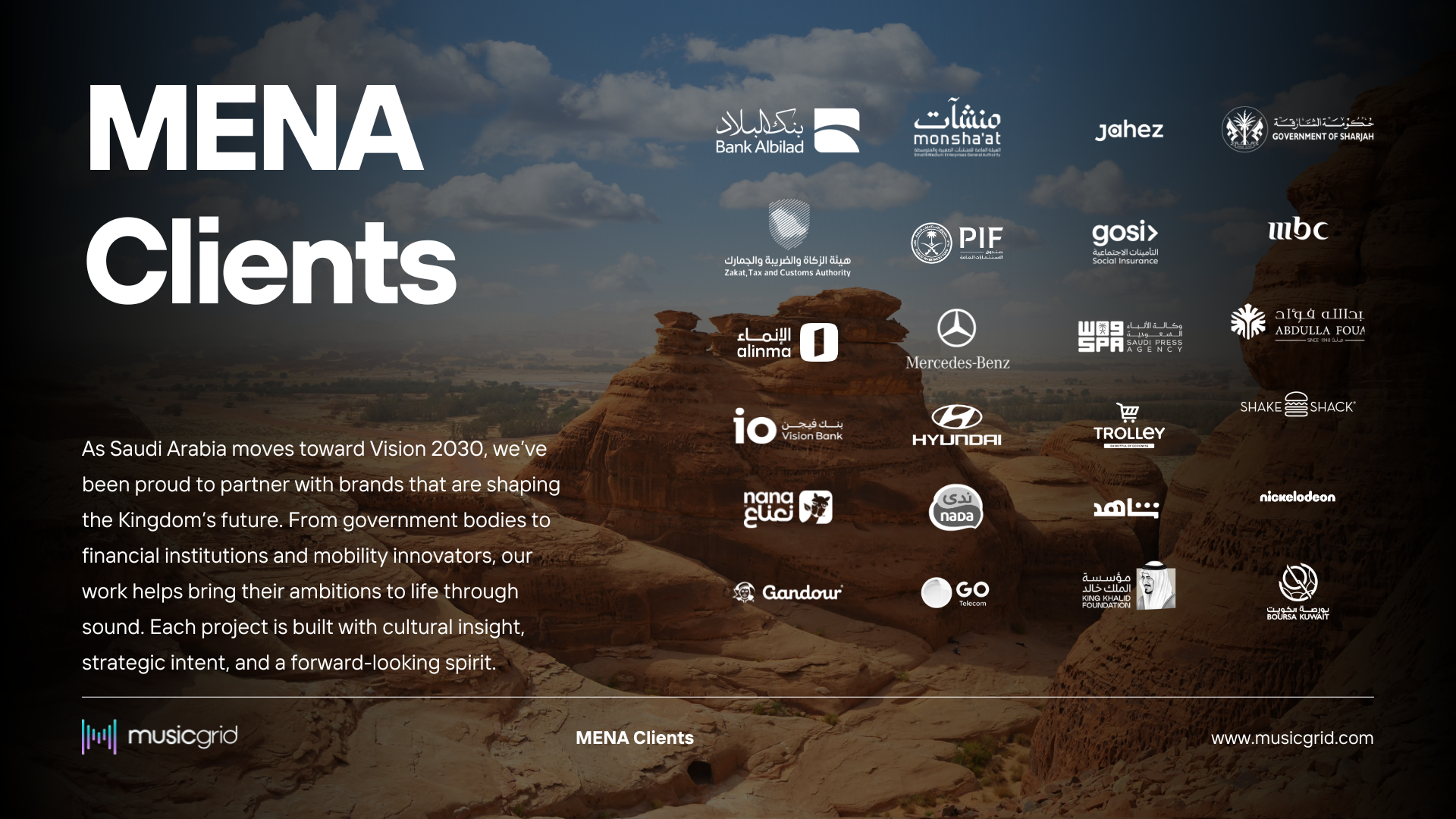
MusicGrid creates original music and campaign soundtracks for brands across Saudi Arabia, the GCC and the wider MENA region. Our work brings together brand strategy, regional insight and original composition to create music that supports the campaign while strengthening the brand behind it.
Contact MusicGrid to discuss the music direction for your next campaign.
.jpg)

.svg)

.svg)
.jpg)
.jpg)
.jpg)
.jpg)
.jpg)
.jpg)
.jpg)
.jpg)




.jpg)



.png)
.png)
.png)
.png)
.png)
.png)
.png)
.png)
.png)
.png)
.png)
.png)
.png)
.png)
.avif)
.jpg)
.jpg)

.png)
.png)
.png)

.png)

.png)







.png)
.png)
.png)
.png)
.png)
.png)
.jpg)
.jpg)
.jpg)
.jpg)
.jpg)
.jpg)

.jpg)
.jpg)
.jpg)
.jpg)
.jpg)
.jpg)
.jpg)
.jpg)

.png)
.jpg)

.jpg)

.png)
.png)


.png)
.png)


.png)
.jpg)
.jpg)
.jpg)

.jpg)
.png)
.png)
.png)

.svg)
.svg)


.svg)
.svg)

.svg)


.svg)